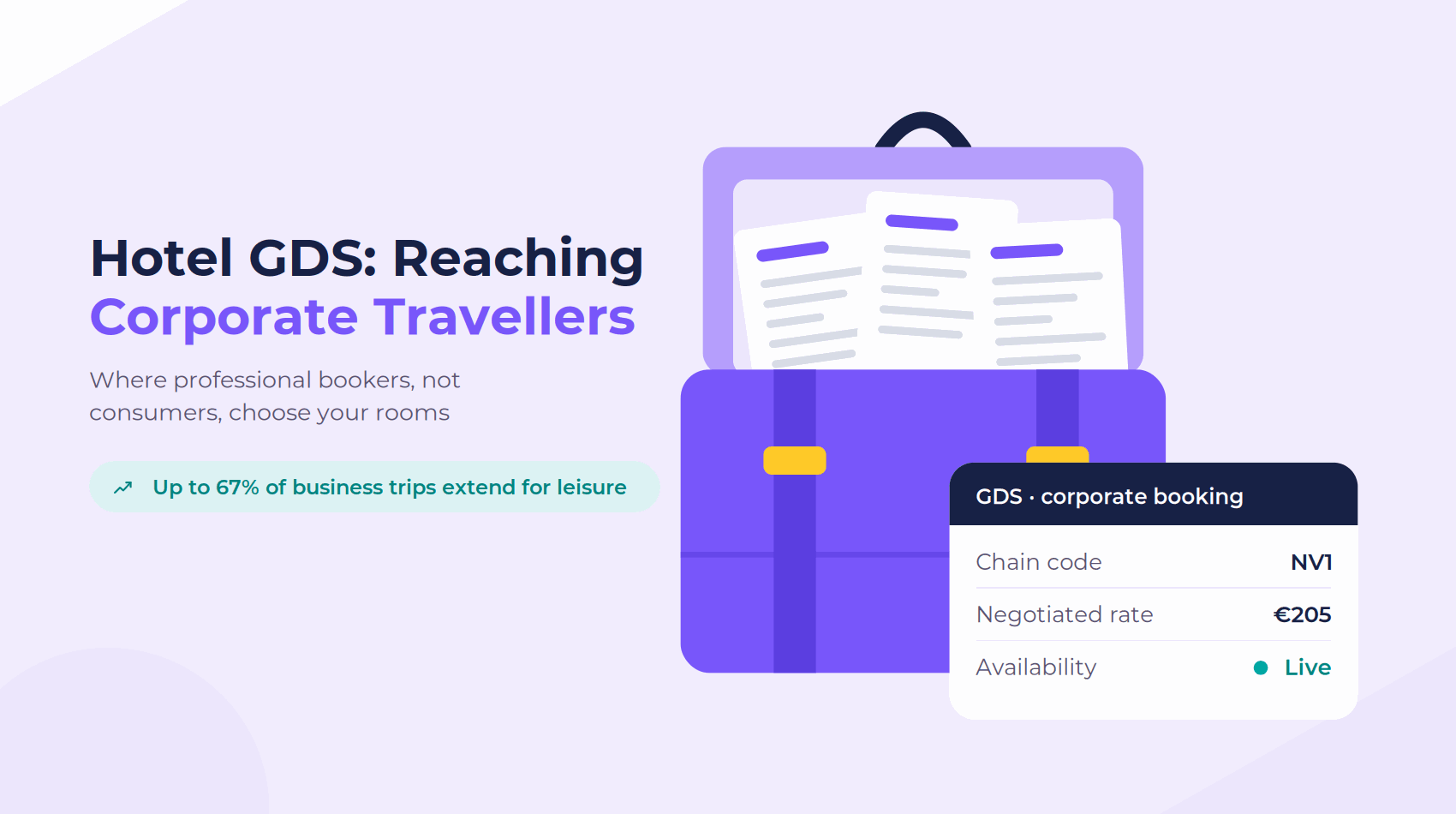
For independent hotels, weekday room bookings can be difficult to attract. This is because most such travelers are workers, and most corporate bookers aren’t using OTAs or search engines to find their results. Business travel planners work inside corporate booking tools that draw their inventory directly from a global distribution system (GDS).
For independent hotels, business travel can pose a big advantage. Corporate travel bookers are a lot more steady, stable, and indifferent to bargains that drive holiday and leisure bookings. Business bookings also flow through infrastructure that most independent hoteliers assume is closed to them. The truth? It isn't. Rather than contracting with GDS providers directly, hotels can tap into this resource through single distributors, in the same way a hotel booking engine connects to other channels.
This tactical guide covers everything you need to know about accessing the GDS, what the providers may cost, and how to judge whether your hotel property qualifies for it.
Ready to expand your client reach? Book a free demo with a Noovy expert today and learn how our industry grade tools can help you tap into business travel.
Table of Contents
What Is a Global Distribution System?
Three GDS Networks: Why Amadeus Matters Most in Europe
GDS vs. OTAs: Where It Fits
Why Corporate Bookings Behave Differently
Does Your Hotel Actually Qualify?
What GDS Actually Costs
Connecting and Loading Corporate Rates
Winning Business Once You Are Listed
Hotel GDS: Wrap-Up
Frequently Asked Questions
What Is a Global Distribution System (GDS)?
A global distribution system (GDS) is a digital network that centralises the travel inventory of agents, travel management companies and corporate bookers that sell it. GDS networks carry flights, trains, car hires and hotel rooms in a single searchable hub, enabling bookers to assemble full trips without ever visiting supplier websites.
A GDS also centralises hotel listings and places them in front of professional bookers rather than just consumers. In a GDS, the person searching for a room is a travel agent, corporate travel manager, or an employee booking within their company’s policy. It’s that policy, not price comparisons, that largely govern what they choose to book.
There are three main GDS networks that dominate the industry, and those are Amadeus, Sabre and Travelport.
What is the difference between a GDS, CRS, and Channel Manager?
To begin, let’s clarify the difference between three key terms that are often confused for each other. This confusion can cost hoteliers lots of money in duplicated software. A GDS, CRS, and Channel Manager do completely different jobs, sequentially rather than competitively:
- Central Reservation System (CRS): A hotel CRS is a software tool that holds and manages real time room rates, availability, and restrictions in a centralised system.
- Channel Manager: A channel manager distributes a hotel's available inventory on the internet to various OTA channels (such as Booking.com) and other sources. It also automatically synchronises prices and availability in real time.
- Global Distribution System (GDS): The GDS is one channels that a hotel channel manager can distribute available inventory to. It is a destination, not a product.
With this logic, a GDS booking system is not something a hotel can buy. Instead, a GDS can be better understood as a plugin that embeds into your existing hotel management stack. Therefore, if room rates are wrong in the GDS, the fault is almost always upstream in the CRS or the channel manager feeding it.
Three GDS Networks: Why Amadeus Matters Most in Europe
For an independent hotel in Europe, all GDS networks are not equally relevant. Amadeus has the strongest agent base across Europe, totaling around 40% of all corporate bookings in Europe (DMC, 2025). This makes it the most important channel for boutiques in the UK, Netherlands or Germany where meaningful corporate travel happens. Amadeus is used heavily by European travel management companies (TMCs) and corporate travel departments.
Sabre is the strongest GDS in North America, and holds around 35% of global corporate travel distribution (DMC, 2025). While largely irrelevant for domestic business travel, this channel matters for independent hotels in locations that attract inbound American corporate travel, such as Amsterdam, London or Frankfurt. Travelport runs a smaller network in comparison to the other two, with particular strength among independent agency groups.
In most cases, GDS connectivity is sold as a bundle. As such, the important question is not which GDS, but rather which provider to choose, what they charge, how they handle content, and whether they support the consortia programmes relevant to your market.
GDS vs. OTAs: The Hotel Distribution Mix
GDS and OTAs are not competitors, as they target different travel segments. While OTAs reach consumers directly, a GDS reaches professional intermediaries. A guest on Booking.com is choosing for themselves and paying with their own money. A booker in a GDS is choosing for someone else within company policy constraints.
As a result, many independent hotels run both channels simultaneously, just with different rates, bundles, and cancellation policies. While balancing OTAs and direct bookings is the foundation of any independent hotel, a GDS can be a third addition to the channel mix for hotels with genuine corporate demand.
Why Corporate Bookings Behave Differently
To put simply, corporate bookings are worth pursuing not because there are more of them, but because they behave better. There are four differences that matter commercially:
- Policy Driven, Not Price Driven: A corporate booker working within a travel policy checks company compliance more than just aiming for the cheapest rate. This protects rate integrity for independent hotels in a way OTA demand actively does not.
- More Weekday Bookings: Business travelers concentrate on Monday to Thursday and hold a steady demand through low seasons, making demand forecasting much more reliable than with seasonal tourism.
- Less Cancellations, More Repeats: Corporate bookings are less likely to be cancelled, and more likely to be repeated. A trip booked against a confirmed meeting happens, and the same traveller returns to the same city several times a year.
- Potential Leisure Extensions: Blended travel experiences are where independent hotels hold the real advantage over corporate chains. A business traveller extending their stay will not choose the airport motel they tolerated for work. Hotels with character can become an easy route to leisure business clients.
Does Your Independent Hotel Qualify for GDS?
Most content about hotel GDS distribution is published by companies selling GDS placements, which makes it hard to find honest qualification advice. To make matters easier, here are the five main criteria to determine whether corporate demand is realistically available to your hotel:
- Location: City centre, business district, airport area, or near conference halls. Corporate demand is geographic before it is anything else.
- Room Count: Enough inventory to accommodate corporate bulk reservations without displacing higher-yield demand for the strongest performing hotel nights.
- Average Daily Rate (ADR): Since much of the costs are fixed per booking, hotels with a low-ADR will struggle to offset the cost of GDS connectivity.
- Existing Corporate Signal: Are there repeated business names in the hotel PMS? A GDS can amplify hidden corporate demand; but it rarely creates it from nothing.
- Business Amenities: Reliable digital connectivity, urban location, personal room desk, lobby work area, early breakfast, and quiet rooms can all qualify.
In contrast, independent hotels in rural areas with a low-ADR and high focus on leisure are probably not going to benefit from GDS connectivity. Such hotels risk paying connectivity fees against bookings that will never arrive, and that money can be best used for improving the hotels digital presence on OTAs instead.
What GDS Actually Costs
GDS pricing is very component based, making it difficult to draw meaningful comparisons. Generally, the total cost of GDS connectivity contains a one-time setup fee, monthly maintenance fees, and a commission or transaction fee of 10-15% per booking.
Here’s a full breakdown of typical components, payment structures and associated costs of GDS connectivity. Keep in mind, these are estimates and real GDS connectivity costs can vary widely depending on circumstances:
| Component |
Payment Structure |
Cost |
| Integration Fee |
One-time payment. |
€200 to €2,000+ based on integration complexity. |
| Connectivity Fee |
Recurring subscription. |
€9 - €90 per month to keep the property updated. |
| Per-Transaction Fee |
Fixed percent per booking. |
- |
| Travel Agency Commission |
Percentage of booking value. |
Typically a 10 - 15% commission per booking. |
| Consortia Programme Fees |
Annual fee, per programme. |
Optional; buys access to specific agency networks. |
To understand cost efficiency, there is a key difference between OTA and GDS connectivity worth highlighting. Unlike OTAs that charge heavy commissions across all bookings (variable), GDS commissions rely more on fixed transaction charges (fixed).
As a result, GDS connectivity is most cost-efficient for hotels with an Average Daily Rate (ADR) above the median. This is because fixed costs amortise as your rate rises (GDS), whereas proportional costs do not (OTA).
That’s why ADR determines whether GDS connectivity is worth it or not, and why the same fixed fee is comfortable for one hotel and totally unworkable for another. Confused? Here’s a case study example to illustrate the difference:
The Role of ADR in GDS Viability
Let’s assume some key numbers that both Hotel A and Hotel B will share. The only difference we will set is a different ADR; one below the median, and one above:
- Annual Connectivity Fee: €1,200 annual fee.
- Per Booking Transaction Fee: €12 per booking.
- Agency Commission: 10% commission.
- Bookings Per Year: 100 GDS bookings.
- Average Stay Length: Two nights.
With our figures in place and some essential formulas to calculate with, let’s have a look at the results of our two hotels with GDS connectivity:
| |
Hotel A |
Hotel B |
| ADR |
€85 |
€240 |
| Annual GDS Revenue |
€17,000 |
€48,000 |
| Connectivity Fee |
€1,200 |
€1,200 |
| Transaction Fee |
€1,200 |
€1,200 |
| Agency Commission |
€1,700 |
€4,800 |
| Total Annual Cost |
€4,100 |
€7,200 |
| Effective Cost |
24.1% |
15% |
Despite both independent hotels having the same cost breakdown and volume of bookings, Hotel A has a comparably poorer arrangement than Hotel B, which pays materially less. Nothing changed here other than the ADR.
Connecting to GDS and Uploading Corporate Hotel Rates
Independent hotels should connect to the GDS with connectivity providers, rather than contracting each network directly. Some CRS and channel manager providers include GDS connectivity as part of a package deal, while others may require a specialist partner.
Once a hotel is connected, they will be assigned a unique chain code. This is a short identifier code agents use to find the hotel on the GDS. From here, a hotel's approach to their online profile matters significantly. Here’s what the process looks like:
- Structured Content: Whilst on OTAs, the aesthetic of a hotel matters a lot, for GDS it’s informational precision. Thorough structured content helps corporate bookers easily see room type codes, amenities, distance to airport values and rate descriptions.
- Rate Loading: There are three types of rates that can exist on a GDS. Corporate negotiated rates locked to an individual company's code; consortia rates offered to agency networks for preferred placement; and dynamic rates that move alongside a hotel's public pricing.
- Going Live: Once everything is in place, the GDS then becomes another key channel drawing on a hotel's inventory. Here, the same rules as any hotel listing apply, for example, if room availability is not live synchronised, adding an extra channel can further complicate things.
Winning Corporate Business Travelers Once Listed
Being listed on the GDS is not the same as distribution. Most independent hotels face a common disappointment: a hotel connects, waits, sees little gain, and concludes the channel does not work. Usually, it was never activated.
Here are the three key ways by which independent hotels can maximise their GDS distribution:
- RFP Season: Corporate travel bookers negotiate their preferred rates annually, usually in late summer for the following year. Hotels that miss this window have to wait until next year. Preparation for this window should include accurate content, a defensible rate, and a clear statement of why your property suits company travellers.
- Consortia programmes: These are open agency networks that hotels cannot reach individually. Each programme carries a fee, and thus it’s recommended for hotels to choose selectively based on which agencies actually place business in their city.
- Local Targeting: For most independent hotels, local corporate accounts remain the relationship with the highest potential. The best part? They require no GDS at all, as they are local. Nearby business headquarters and local employers are worth a phone call as these clients come with no agency commission, transaction fee or connectivity fee. If your hotel scored low on the qualification test, start here.
Corporate Readiness Checklist Before RFP Season
To make sure independent hotels are prepared in advance of RFP season, we’ve put together a comprehensive checklist designed to yield the best results:
- Structured Content: Is there clear documentation of all hotel room types, amenities, distances to key points, and meeting capacity?
- Photography: Are all the hotel images up to date and correctly captioned?
- Rate: Is there an agreed pricing strategy in place? Is displacement considered?
- Booking History: Is there a report of the previous years corporate bookings as potential evidence of demand?
- Target Audience: Is there a target list of main companies with either local employers or direct bookers?
- Software: Does the hotel have an active CRS and channel manager in place to make sure availability is synchronised across every connected channel?
- Point of Contact: Is there a named person in the hotel who will own corporate accounts and RFP responses?
Hotel GDS: Wrap-Up
The Global Distribution System (GDS) can be a high-value channel for the right hotel, and a poor investment for the wrong one. The difference is in knowing whether or not a hotel qualifies and has potential in advance.
By analysing factors such as location, room count, ADR and existing corporate signals, a hotel can learn a lot more about their potential than any vendor will honestly tell them. For hotels that qualify, the demand is definitely worth it. Midweek bookings driven by policy and resistant to discounting. Furthermore, many corporate bookings also extend into leisure nights, allowing independent hotels to capture guests better than chains.
To wrap up, a GDS hotel listing is only ever as good as the accuracy of its structured data. In line with hotel management best practices, it’s important that prospective hotels keep rates and availability accurate are the prerequisite for every channel that is added.
Why Noovy?
Rather than selling GDS representation, Noovy offers you something better: complete and seamless oversight of all your booking channels. Whether it’s GDS, OTA, metasearch or direct, our world class tools ensure your inventory behind it stays accurate:
- One pooled inventory across every channel. Your PMS, booking engine and channel manager draw on the same live availability, so there is no reconciliation step and no window in which the same room is sellable twice.
- Rate management built for channels with different commercial logic. Corporate negotiated rates, consortia rates, OTA rates and direct rates behave differently. Managing them in one place shows you what each channel actually produces.
- Built for independent hotels. Channel expansion should not require major costs or a dedicated distribution manager. Noovy is designed for small to mid sized hotels, and provides the revenue management features needed to handle business with ease.
Ready to expand your hotel into business bookings? Book a free demo and see how Noovy keeps every distribution channel accurate from a single, connected platform.