

The Net Operating Income Drain
That missing €45 isn't just a small administrative fee. It's money pulled directly from your property's net operating income that should be funding your sourcing, maintenance, and staff compensation.
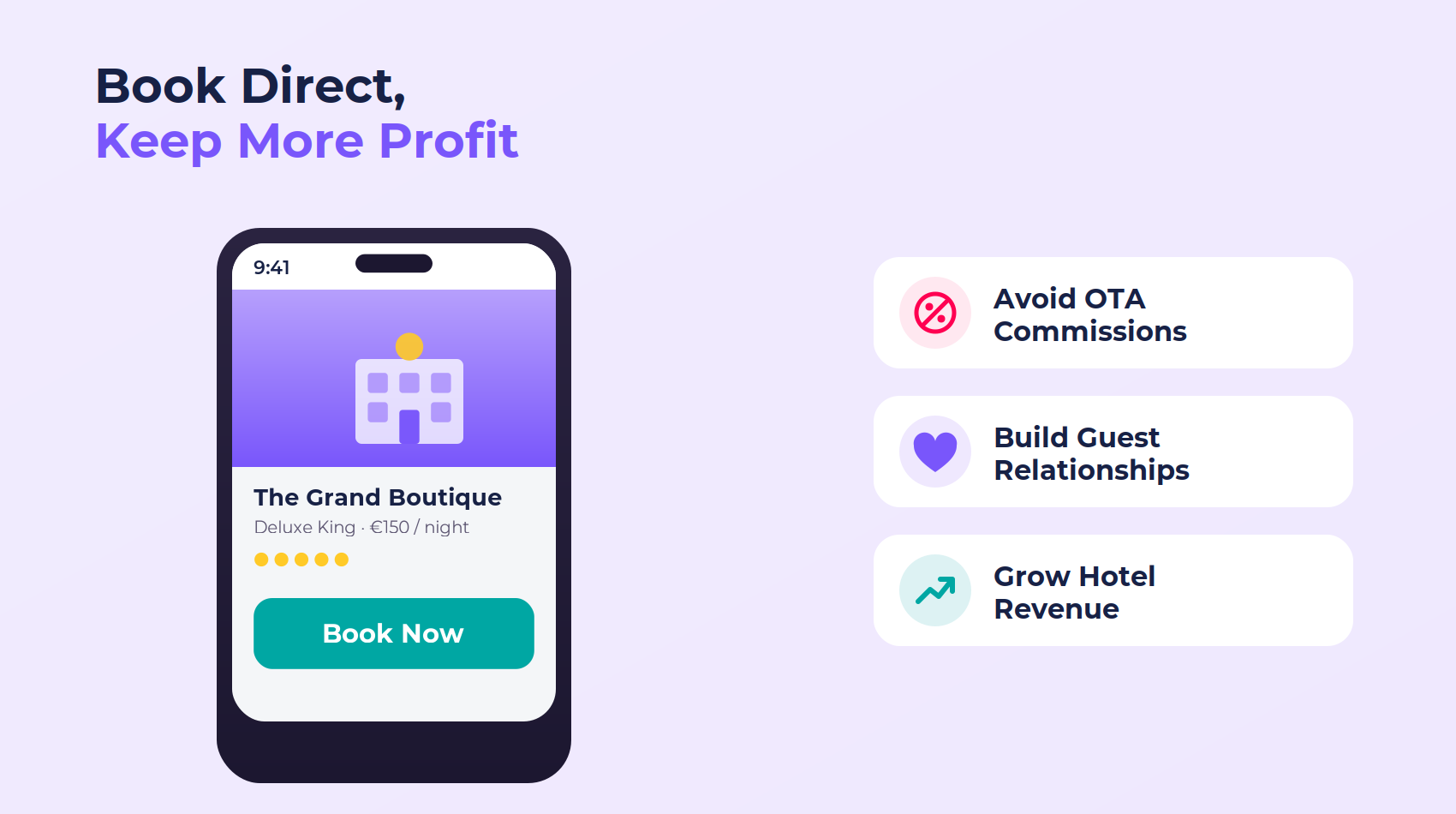

High occupancy rates don’t always signal a successful hotel operation. While it may feel like a victory, monthly profit and loss statements often tell a different story. Third-party online travel agencies (OTAs) charge commissions of up to 30% per booking, which can significantly eat away at a large chunk of a hotel's revenue potential.
That’s where dedicated hotel channel manager software becomes important. These vital platforms are used for broadcasting live hotel room availability across global distribution networks simultaneously, ensuring real-time accuracy. However, it’s important to remember that a channel manager is strictly a distribution system, and will not build relationships with customers.
This tactical guide is designed to bridge the gap between an initial, anonymous guest arrival and a dedicated, loyal recurring guest. Discover how to move beyond passive distribution and tap into the value of modern guest relation management.
Ready to turn strangers into loyal guests? Book a free demo of Noovy’s modern hotelier tech stack and get a thorough demonstration by one of our experts today!
To build an independent hotel brand that can thrive in the long-term, managers must answer a foundational question: what is guest relations in the age of modern hospitality?
Historically, properties viewed hotel guest relations as a reactive customer service. A guest has a need, they communicate it to the hotel, and the hotel satisfies it. Usually, customer services stopped at the front desk; a physical place where visitors go to request an extra pillow, complain about a lost key, or ask for local recommendations.
Modern guest relationship management is much more expansive. Today's digital automation tools turn guest relations into a data-driven revenue strategy. In simple terms, every piece of guest data plays a part in maximising hotel profit and guest satisfaction.
Guest relations have become a lot more predictive. Instead of waiting for guest complaints, modern hospitality tools gather data and form full guest profiles that enable hotel teams to predict what a guest wants. This helps create tailored guest experiences, niche offers, and marketing campaigns that increase the chance of loyal customers.
When hotels systematise their guest relation workflow, they can create a structured framework designed to turn first-time bookers into a permanent, loyal guest base.
Relying too heavily on third-party platforms creates an optical illusion of success. It’s easy to celebrate a completely full house, but focusing exclusively on occupancy rates ignores the ongoing rise of your hotel customer acquisition cost.
When an independent hotel uses only external channels to fill rooms, third-party distribution fees and commissions extract a massive chunk of the money. Consider a standard room at €150 per night. If this reservation passes through an OTA platform charging a standard 30% commission, the hotel loses €45 before the guest even checks in. Multiply this by every booking and the hotel is losing thousands every month.
This is where direct booking becomes important. Failing to transition these visitors into direct bookers forces the hotel to buy back the exact same guest at the same high cost the next time they decide to stay at the hotel.
Therefore, proactive guest retention is the single fastest way to reduce OTA commissions and protect your hotel's baseline profit margins.
To increase direct hotel bookings, it’s important to navigate modern hospitality tech with a balanced approach. It's wrong to suggest that hotels should abandon third-party distribution as platforms like Booking.com act as an excellent digital billboard, introducing hotels to travellers around the world who would otherwise never discover the brand.
The trick to learning how to increase direct bookings for hotels lies in understanding exactly where one system ends and the other begins. A hotel channel management software has one clear job: to manage visibility and bring new guests to the door. The moment a reservation is made, that tool's job is complete, and the guest retention strategy takes over.
By using internal tools to retain the guests that the external tools brought, hotel bookings can be steadily increased while acquisition costs are kept remarkably low.
Building an approach that captures and retains business doesn’t always require a massive advertising budget. With structured hotel direct booking strategies, independent boutiques can systematically increase both revenue share and guest loyalty. For hoteliers wondering how to get more direct bookings, and how to increase direct hotel bookings without slashing rates, the three-step playbook below can be implemented immediately.
One of the largest hurdles to increasing hotel bookings is the email masking carried out by major online travel agencies and third-party networks. When a guest books through an OTA, their contact details are hidden behind aliases (e.g. guest123@booking.com), making it impossible for a hotel to contact and market to this guest.
To fix this, hotels can use structured digital check-in tools. For example, adopting a mobile check-in option can prompt guests to complete a quick form upon arrival that also captures their email address and phone number, establishing a communication channel for future stays.
Rate parity agreements imposed by third-party networks can make it difficult to increase hotel direct bookings without violating the terms. In fact, in 2025, over 10,000 hotels across Europe filed a joint class-action lawsuit against Booking.com for two decades of rigid anti-competitive practices that stifled hotel operations (The Guardian, 2025).
Luckily, there's a simple strategy to easily outcompete third-party channels without needing to lower room rates: focus on value, not price. By bundling exclusive on-property values that third-party platforms cannot match, hotels can capture guest attention.
Prominently feature complimentary perks like:
Once a hotel has captured a guest's contact details, it’s a common mistake to send impersonal and generic newsletters that do little to capture and convert attention. Instead, hotels should use guest history logs collected by their CRM to deploy highly personalised and targeted guest loyalty initiatives through automated guest relationship systems. Some examples are:
To understand the financial case for guest relationship management, hotel operators can calculate exact revenue recovered by minimising third-party distribution. In general, direct bookings yield up to 60% higher profits than OTA bookings (Hospitality Net, 2026).
Independent hoteliers can use this formula to calculate how much gross commission leakage is being reclaimed through direct hotel bookings:
Imagine an independent hotel that successfully converts 150 repeat bookings away from third-party platforms over the course of a year. The hotel maintains an average daily rate (ADR) of €160, an average length of stay (LOS) of 2 nights, and faces a standard third-party platform commission (Baseline OTA%) of 18%.
By reclaiming €8,640 per year from just converting a small fraction of the total guest volume, it becomes clear how much of an impact direct booking can have on hotel profits.
The relationship between fostering guest relationships and increasing direct bookings is close, but both require particular strategies. For guests to become direct bookers, hotels need to provide incentives to do so. In turn, to keep direct bookers loyal, hotels need to ramp up their guest retention strategy through tailored marketing campaigns.
OTA channels can still serve as a useful billboard, broadcasting a hotel to a much wider global audience; however, a healthy channel mix that prioritises direct bookings will ensure a hotel is maximising its net profits.
Noovy bridges the gap between distribution and retention seamlessly. Our cloud-native hotel management platform is built to help independent hoteliers break free from third-party commission dependencies without adding to their administrative workload:
Ready to optimise your stranger to loyal guest funnel? Book a free demo with a Noovy expert today, and discover world class hotel technology designed to boost your profits.