Package Contribution = Package Price − Variable Cost of Room − Cost of Inclusions
Perceived Value Ratio = Total Perceived Value of Inclusions ÷ Total Cost of Inclusions


There is no shortage of hotel package ideas that can spice up a hotel stay. Spas and wellness, romantic dinners and inclusive breakfasts, sightseeing tours and local activities. Whilst each and every option may seem attractive, none of this tells you what to charge for a hotel package, nor whether it will perform effectively or not.
There is a simple mechanism to keep in mind; a package offer and a discount are not the same thing. A hotel package gives a guest something they perceive to cost €100 for €12 of the actual cost. A discount gives a guest €25 of value for exactly €25. The generosity may be the same, but it has a very different outcome on your margin.
This tactical guide is designed to provide hotels with the best hotel management practices for hotel package making that adds contribution to your hotel rather than hindering profit. Read on to learn about key hotel package ideas, common pitfalls and how to avoid them, as well as methods to see whether a hotel package worked.
Ready to boost hotel sales with a modern hotel management system? Book a free demo with a Noovy expert today to see how we can propel your hotel to the next level!
Table of Contents
Why a Package Beats a Discount
Hotel Package Ideas That Actually Sell
Where Packages Fit in Your Sales Approach
Promoting a Package Without Discounting It
How to Tell Whether a Package Worked
What Is a Hotel Package?
A hotel package is a room booking sold with one or more additional products or services; all wrapped up in a single price. That way, a guest buys an experience alongside their room. This could be a complimentary breakfast or dinner, a spa treatment, gym access, or even as simple as a late checkout or parking spot.
In this setup, the price offered to a guest on your website or OTA is called a package rate. This is a single price for both the room and provided services, without any segmenting. This matters more than it may seem, because the guest cannot see what each individual offers in the package costs, including the room cost. This way, your rate stays private.
The most important rule of thumb to remember is this: a package adds something, a promotion takes something away. While both approaches bring bookings, only one protects your profits.
Why a Package Beats a Discount

The key reason why a package always beats a discount is because the former costs a hotel a reduction on the potential profit from an add-on, while the latter only costs the value of the provision itself.
In simpler terms, a room discounted from €240 to €160 represents a loss of €80, whereas a €260 room package including a breakfast only costs the provision value of the breakfast. If a breakfast costs €5 to make, then the hotel just profited €15. There are three metrics at play:
- Perceived value is what the guest believes an extra inclusion is worth, based on what they would be willing to pay for it separately.
- Provision cost is what it costs the hotel to provide the extra inclusion, labour included.
- Contribution is the room rate minus the variable cost of selling that room (housekeeping, laundry, amenities, energy).
The gap between the perceived value and provision cost is where the profit margin is. Let’s check out the key formulas needed to calculate this:
Let’s assume a more complex example, and calculate our perceived value ratio. Imagine a hotel with a standard room rate of €120 with the following breakdown:
- Variable cost per occupied room: €25
- Inclusions: €12
- Perceived value: €70
- Package cost: €145
| Standard Deal | Discounted (€25) | Package Deal | |
| Purchase Price | €120 | €95 | €145 |
| Variable Cost | €25 | €25 | €25 |
| Inclusion Cost | - | - | - |
| Contribution | €95 | €70 | €108 |
As can be seen in the table, both campaigns are a meaningful gesture to the guests, worth roughly €25. As a hotel, one approach removes €25 of contribution from your profits, while the other one adds €13. That is a €38 swing per booking.
With this data, we can divide the total perceived value of inclusions by the total inclusion cost to discover our perceived value ratio, in this case being 5.8x.
There is a longer term effect in play here too. A discount is a publicly visible reduction to room value, which in the long term, creates new guest expectations on your hotel pricing. On the other hand, a package gives no details on cost distribution. This is a particularly helpful low season strategy that still protects your bottom line.
Hotel Package Ideas That Actually Sell

Hotel packages are only as good as the demand for the services. Here are seven key hotel packages examples that recur across independent hotels. Most importantly, we’ve provided an extra bit of information most listicles leave out: what makes each one fail.
| Package Type | Inclusions | Best Suited | Why It Fails |
| Romance | Sparkling wine, late checkout, dinner, room dressing. | Boutique, characterful, two-night minimum viable. | Selling year round kills novelty. Sell only during valentines day and long weekends. |
| Spa & Wellness | Sauna, steam room, pool, masseuse, robe, breakfast. | Hotels with wellness facilities and the capacity to book them out to guests. | Packaging an old spa. Unrefined, all this does is expose the facility negatively. |
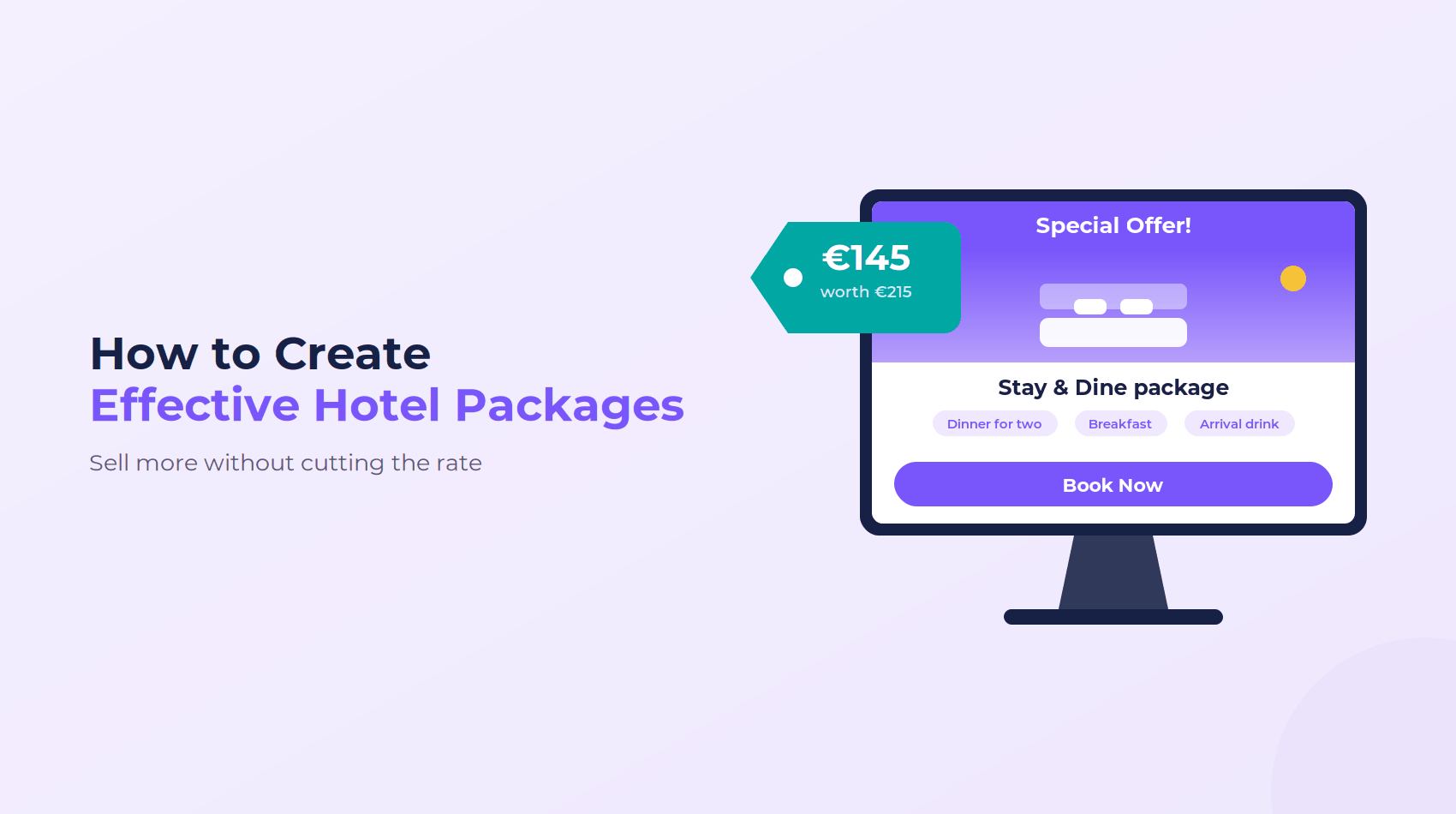
| Stay & Dine | Dinner for two, breakfast, drink on arrival. | Hotels with a kitchen service it controls and prepares food in. | Unprepared restaurants cannot absorb the demand on these nights. |
| Family | Interconnecting rooms, early dinner, activity. | Hotels with various room types to support larger groups. | Offered without checking whether the room inventory actually exists. |
| Local Experience | Partner activity, tickets, transport, guide. | Properties with a genuine local story or interesting surroundings. | Local partners need coordinating and nobody owns this relationship. |
| Extended Stay / Work Trip | Workspace, reliable connectivity, laundry, flexible meals. | City and business district hotels. | Priced per night rather than per stay, so it beats nothing. |
| Events & Occasions | Tied to a local fixture, festival or date. | Anywhere with a reliable annual calendar. | Built once and never refreshed, so it ages visibly. |
The key step to remember here is that hotel packages should be built around what your hotel can deliver consistently, not just around what looks and feels good on your website. A poor promise will do much more harm to your hotel's reviews than not having a package at all.
Most weak hotel packages are the result of hotel managers pushing services that guests don’t want to buy. A hotel with an underused spa may package the spa deal without even asking why it is underused in the first place. Maybe it’s dysfunctional and needs a revamp?
The same applies for local partnerships. While they look good on paper, somebody from the hotel team needs to maintain the relationship, reconcile the billing process, and make sure any changes to the agreements are reported in time.
Hotel packages are a year round instrument that plays a critical role on the guest experience.
How to Price a Package

Pricing a hotel package successfully is a six step method. It’s highly recommended to follow the process in order, as most hoteliers start from step four:
- Start from variable cost, not room rate. The aim is to protect the hotel margin, not revenue. Before anything, calculate the variable cost per occupied room (housekeeping labour, laundry, supplies and breakfast divided by room-nights sold).
- Calculate what every inclusion costs you. A dinner priced for €30 might cost you €9 to make, so that €9 belongs in the calculation. This also applies to labour costs.
- Estimate an honest perceived value. Based on findings, what would a guest pay for the inclusions your hotel provides separately? This is where packages tend to go wrong by pricing too highly.
- Set the price below perceived value and above cost. Make the package attractive while offsetting the hotel costs of providing the package in the first place.
- Fence the rate. Create commitments to make sure offers generate income. Minimum stay windows, advance purchase, specific dates are just some examples.
- Check demand before launching. If your hotel is experiencing good sales, a package deal may accidentally convert full-rate bookings into cheaper ones.
Particularly for steps five and six, a solid system with modern revenue management features are essential for an easy, practical application.
Where Packages Fit in Your Sales Approach
In any well-rounded sales strategy, there are three ways by which an independent hotel can raise the value of their booking:
- Charge a better room rate.
- Sell a longer stay.
- Sell a larger value.
Hotel packages fall into the third option, and among the hotel room sales techniques available to an independent hotel, it is the most underused.
The timing of a hotel package can make the hard work of setting it up worthwhile. A hotel package offered during the booking process, versus one offered at check-in produce different results, and both may be worth testing. A modern hotel booking engine is crucial for this step, as it can help present add-ons at critical points of decision.
When balancing OTAs and direct bookings, the core aim is to maintain a direct booking funnel where possible. A package only available on your website that provides inclusions not offered on an OTA can give concrete reasons to guests to book directly with you, saving you up to 30% on commissions.
Promoting a Package Without Discounting It
For the best results, it’s recommended to promote hotel packages on your own website and booking engine. Your profit margin is best there, and it’s the only place where you can control how your hotel packages are described. This matters, because a guest is essentially buying something they cannot necessarily see.
Existing guest profiles are the cheapest and most reliable audience for anything new in your hotel. A package marketed to past guests who were already satisfied with their stay costs nothing (since you own their contact details) and has a higher conversion rate than paid ads. With automated guest communication, this entire process can be turned into a routine.
As a rule of thumb, prioritise clear and specific language, such as:
- “Late checkout at 14:00” instead of “flexible departure”.
- “Three course dinner for two persons” instead of “dining included”.
- “Unlimited sauna and steam room access” instead of “spa amenities provided”.
Combined with social media campaigns designed to drive bookings, a hotel package can be marketed successfully to both previous guests and newcomers alike.
How to Tell Whether a Package Worked
Three numbers tell you whether a package earned its place, and most properties check none of them. Measure in this order, because each one can reverse the conclusion of the last.
- Attach Rate: This is the share of bookings in the eligible period that took the package. A low attach rate usually means the perceived value was not obvious at the point of decision rather than that the package was wrong — a presentation problem, not a product one.
- Contribution per booking against base rate: This is the number that actually matters. A package selling well at a contribution below what the room alone would have earned is a problem disguised as a success, and it is the commonest way a popular package quietly loses money.
- Displacement: This is what catches the rest. Did it fill nights you would have sold anyway? If so, you converted full-rate bookings into discounted ones and the attach rate flattered you. Compare the same weeks against the prior year — your analyse market trends reporting is the place to do it.
Then fix the review in the diary. Packages get retired when someone remembers to look, which is why so many properties still run an offer built three years ago for a market that has moved.
Hotel Packages: Wrap-Up
A hotel package is a pricing instrument before it is a marketing one. Whilst there are endless possibilities of ideas to explore, the ones discussed in this article are proven approaches that are designed to work. Why? Because guests want them.
What then separates a hotel package that makes money from one that simply fills rooms at a loss is how well the idea was executed: the pricing strategy, estimated perceived value, fencing, and post package launch measuring to stay on track.
Start easy. Price a package thoroughly, launch it, and review its performance after ninety days. That will teach you more about your specific hotel margins than any article could.
Why Noovy?

Noovy does not design hotel packages, but what we do provide is the full infrastructure that decides whether a package can be sold properly and measured honestly. We include:
- A booking engine that sells packages, not just rooms. Most vendor booking engines stop short at room sales, whilst the Noovy booking engine presents extras and inclusions right at the point of decision, leading to high yields.
- Effective rate and restriction management. Minimum stays, advance purchase windows and date restrictions applied where they are meant to.
- Full performance reports. Measuring a hotel package performance is only realistic if the numbers are legit, aggregated, and obtained in real time, just as Noovy does.
- A centralised guest record. That way, the cheapest audience for a new package is reachable without reconstructing a list from scratch every single time.
Ready to elevate your hotel operations? Book a free demo to see how Noovy can turn a hotel package from an idea into something you can price, sell and measure.