


What is Unconstrained Demand?
Unconstrained Demand is the total volume of consumer booking interest your property could secure for a given date if your physical room capacity were completely infinite and unrestricted.
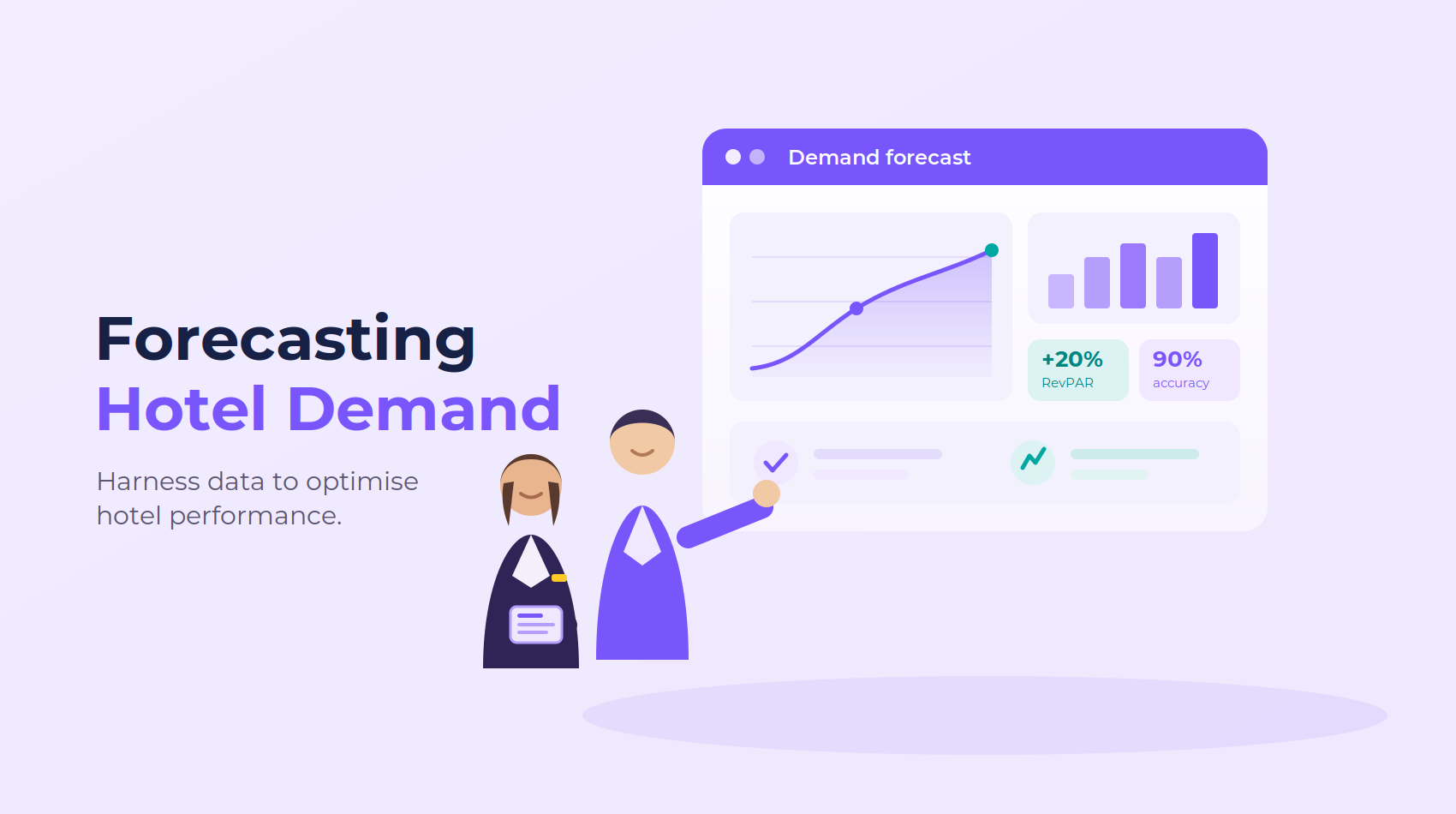

Traditionally, hotel predictions felt more like guesswork than data science. In modern hospitality, this problem is accentuated as hoteliers find themselves preoccupied with running a property to accurately predict rates in time. As a result, many properties default to survival tactics such as adjusting for inflation and hoping for the best.
Luckily, modern cloud-based revenue management systems (RMS) have helped simplify demand forecasting in the hotel industry by automating the collection and analysis of booking patterns. This way, independent hoteliers can proactively set hotel demand based pricing and marketing spend, instead of panicked and reactionary decision making.
Our tactical guide breaks down how RMS hotel forecasting software transforms guest data into a real-time predictive machine, allowing you to adjust profit benchmarks, eliminate manual labour, and regain complete control over your hotel's inventory.
Ready to boost your hotel performance? Book a demo of Noovy’s state of the art RMS today and see automated hotel demand forecasting in action.
Only 1 in 10 independent hotels in the EU use a modern RMS to build hotel forecasts, while many still rely on classic spreadsheets built on human input (360 Research Reports, 2026). While historical data provides a baseline forecast, spreadsheets give no clarity for real-time demand, and rely entirely on individuals inputting information into them.
Consider a simple analogy: using last year’s forecast spreadsheet to set tomorrow’s room rates would be like trying to drive a car while only using the rearview mirror. Without a real-time view of the road, driving becomes an experiment of trial and error. When running a hotel like an experiment, revenue leakage becomes inevitable.
Here are of the main downsides to relying on traditional demand forecasting in hotels:
For this reason, transitioning to a modern revenue management system (RMS) for demand forecasting is no longer a preferential luxury, but an essential component in a hotel's long term survival in the modern market.
To successfully forecast hotel occupancy, transitioning away from manual spreadsheets is important. Despite expectations, this does not require advanced data knowledge and is surprisingly easy. The best modern cloud based RMS technologies are as intuitive as the apps we use every day. They simplify and automate calculations, translating raw data into clean, actionable metrics presented in polished dashboards.
To understand and leverage predictive demand forecasting, a hotelier only needs to understand the two foundational building blocks of property demand:
A booking curve is the continuous timeline of how hotel room inventory fills up as a particular arrival date approaches. These cumulative bookings are usually visualised as a line diagram, and often follows a distinct S-shape, reflecting typical traveller behaviour.
By tracking a booking curve, an automated RMS begins to establish a historical pick-up pace. Think of this like a speedometer for a hotel. If the RMS knows that in October, a hotel usually sees 4 bookings a week, but suddenly registers 43 bookings in a single morning, the predictive engine then understands that the pick up pace has steepened.
As a result, the system instantly flags this increase and issues an alert that demand is higher than normal. This makes sure a hotel's physical capacity isn’t constrained without knowledge.
One of the main shortcomings of hotels with traditional demand forecasting is the assumption that being 100% fully booked is always a flawless victory. When the spreadsheet shows a full house and the manager assumes the pricing strategy was perfect, revenue is often missed.
In reality, filling every last room two weeks before any arrival can mean a hotel has capped its earning potential early. In fact, there is a hidden volume of travellers who would have willingly paid double the standard rate just to book in those final two weeks.
Key modern RMS tools can analyse website search volumes, click-through rates, and even denials and regrets to calculate a prediction of this unconstrained demand. By analysing the degree of total interest in a hotel, the RMS keeps rates and availability fluid. Instead of selling out prematurely to low-yield bookings, the system saves a portion of high-margin rooms for late bookers who are willing to pay premium rates.
Managing hotel seasonality means understanding demand patterns, and how to tell apart a normal lull from a real downturn. Predictive revenue management for hotels does exactly that: it measures your live pick-up against multi-year baselines.
Every hotel understands the basic seasonal patterns of their local market, however, micro-shifts in those demand patterns are very hard to spot without an advanced RMS. A modern revenue management system helps automate this process and produce a hotel forecast report on demand.
For example, when a month long lull hits in bookings, hotel managers often panic and assume a permanent decline in business. This leads to emotional reactions such as slashing room rates across all OTAs, affecting the hotel's image and standard.
An RMS acts as a safety guardrail to prevent such incidents by matching the real-time pick-up curve against multi-year baselines to help reassure the front office that most of these slowdown periods are entirely predictable and temporary.
That way, an RMS helps keep your baseline rates stable, protecting your brand value and preventing a race to the bottom competition that can take months to recover from.
Strategies for accurate hotel demand forecasting are only as valuable as the action they create. Once a modern RMS calculates a hotel's velocity, it can automatically translate these insights into real-time guardrails for your property management system (PMS).
There are two key ways a hotel’s RMS and PMS work together to create these internal inventory controls and operational rules:
When an RMS driven forecast identifies a high demand weekend ahead, such as a local festival or a seasonal holiday, the RMS doesn't just raise room rates. It first automatically applies an MLOS restriction (e.g. a 2 night minimum) to early bookings.
This might seem counterintuitive, but an RMS works purely with data. For example, if a forecast strongly predicts that Saturday night will experience high demand due to a festival, it can prevent a guest from booking a low-cost single night stay on Friday.
Locking out that single-night ensures that high-demand Saturday bookers have a greater chance at booking a multi night stay at a premium price. These hotel price forecasting strategies help maximise total RevPAR across the entire weekend instead of leaving hotels with empty, unsellable single nights on either side of the demand spike.
Independent hotels often have to navigate chronic staff shortages. This leads to operational challenges that need constant attention, which an RMS helps with. If a demand forecast tracks an intense volume of arrivals concentrated in a specific weekend, an RMS can deploy a close to arrival parameter. This allows guests to stay through a certain date, but blocks new check-ins from occurring on that same afternoon. Here’s what that looks like:
Implementing a CTA rule is an important stress relief for understaffed independent hotels. It protects the high service standards and retains staff by providing a manageable and pleasant environment to work in.
Forecasting hotel room demand through a modern hotel tech stack helps simplify operations and regain countless hours of time back. Lean teams suffer from mundane shadow tasks that drain profit and service quality. An RMS ensures that room demand forecasting and subsequent pricing is handled automatically.
When hotel demand management is accurate and automated, the benefits extend far beyond the pricing dashboard:
Relying on traditional demand forecasting methods keeps independent hotels locked in a toxic cycle of reactive decision making. This constant state of “catch up” erodes profit margins, stresses teams, and disappoints guests. Combined with direct bookings for maximised profit, a modern RMS system can help preserve net profits and survive a competitive landscape.
Here are the main steps to make sure that predictive hotel forecasting is helping your hotel, not hurting it:
At Noovy, we design cloud-native hospitality solutions tailored to remove the operational anxiety of independent hoteliers. We know you don't have the time to deal with corporate econometric models or manage broken spreadsheets.
Our intuitive platform can fully integrate with your existing tech stack, transforming real-time variables into clear pricing recommendations on an accessible dashboard.
Gain enterprise-grade intelligence without the corporate pricing. Ready to optimise your hotel for peak profitability? Book a Demo with the Noovy team today!