Smart hotel technology is easy to buy and hard to choose. Developments with the internet of things (IoT) has resulted in an abundance of vendors, flashy products, and big promises, but which parts of hotel room technology do guests actually care about?
The sweet spot is to find a balance between improving the guest experience, without eradicating the preference for human contact, all while maintaining a feasible spending budget. While some technology may seem impressive at a trade show, it can ultimately confuse a tired guest arriving at midnight after a delayed flight.
Our research driven tactical guide is designed to answer the key question; can a guest use it when seeing it for the first time? Read on for a category by category assessment of the top smart room technologies designed to improve the modern guest experience.
Ready to take your hotel to the next step? Noovy’s all in one hotel management technology is designed to keep both your team and guests satisfied. Book a free demo today!
Table of Contents
What Is a Smart Hotel Room?
Hotel Technology That Guests Actually Use
The In-Room Technologies Worth Installing
Smart Energy Management: Where the Payback Actually Is
Voice Assistants, Privacy and What GDPR Means for In-Room Devices
Making It Work: Integration and the Housekeeping Reset
Where to Start on a Budget
Wrap-Up
Frequently Asked Questions
What Is a Smart Hotel Room?
A smart hotel room uses modern Internet of Things (IoT) technologies for a connected and automated room experience where guests can interact with room features via mobile devices, voice assistants, or control panels.
Whether it’s a guest room that locks and unlocks via a mobile app, smart climate control that knows when you’ve left the room, or voice assisted lighting you can clap to turn on, the future of hospitality is automated. As an added advantage, smart hotel room devices also produce reports, letting the hotel keep track of room statuses and usage without any human intervention.
The key condition that makes a hotel room “smart” is that the technology talks to each other and works in tandem. This way, hotels gain many advantages such as:
- Avoiding heating up an unsold room all afternoon.
- Automatically shutting lights when tenants leave.
- Unlocking room doors via app if the guest lost their key card.
Whilst the phrase smart hotel system implies a single contained system, this is rarely what an independent hotel is doing. Most hotels run three or four semi-connected products from different suppliers, and the communication gaps show up as unnecessary work for your team. The key to solving this is working with a single vendor that provides a fully integrated system like Noovy.
Hotel Technology That Guests Actually Use
Guests use in-room technology for comfort, and they practically ignore everything else. There;s nothing wrong with this, and it would be quite logical that a guest looking to relax would focus on the technology that improves their experience.
Industry research shows that around 69% of guests look for smart hotel rooms when researching, while a further 58% believe that AI can significantly improve the hotel guest experience (Hotel Tech Report, 2025). Needless to say, this technology should actually improve the stay, not complicate it further. Simple examples are:
- A fast and functional Wi-Fi that is easy to connect to throughout the hotel.
- In room streaming on a modern TV that allows for casting connectivity.
- Smart lighting and climate controls that are intuitive and user friendly.
Essentially, anything that needs a demonstration at check-in, or a lengthy printed card explaining how it works, does not need a place in your hotel.
Some guests want none of the modern technology, which is why smart technology should walk a middle path. It should impress guests who like it, and still bring comfort for those who don’t care for it. A simple hotel with fast Wi-Fi and clean mattresses will almost always “out-review” a hotel with a smart mirror nobody cares about.
In-Room Technologies Worth Installing
The full scope of a happy guest experience can be condensed into six core categories, each that offer a smart solution for modern independent hotels. Here’s a full breakdown:
| Technology |
Purpose |
Cost |
Does it pay back? |
| Guest Wi-Fi |
Provides connectivity for the guest. |
Moderate and recurring. |
Indirectly, through positive reviews. |
| Smart Locks |
Keyless access by phone, card or code. |
High upfront, low running costs. |
Yes, it saved staff time. |
| Climate Controls |
Adjusts heating by occupancy and status. |
Moderate. |
Yes, in energy savings. |
| In-Room Screen |
TV casting, service requests, information. |
Low to very high, depending on choice. |
Yes, in replaced printed material. |
| Lighting Controls |
Sensor-driven automation. |
Moderate. |
Yes, in energy savings. |
| Voice Assistant |
Voice-operated controls. |
Moderate. |
No, at best in positive reviews. |
Now that we have a basic overview of the key smart room optimisations for modern hotels, let’s have a closer look at each feature, what it means, and what it can bring for your hotel.
Smart Locks and Room Access
Smart locks for hotels are electronic lock systems that can be operated by phone, card or code rather than a mechanical key. They connect back to the hotel's property management system (PMS) so that access can be issued and revoked remotely.
This hotel improvement tops the list because it is a net advantage to both the hotel and the guest. Not only does it remove extra labour for the hotel team, but further adds convenience for the guest. No cutting keys, no lost key charges, and no guests at the front desk due to demagnetised key cards.
The main question with smart locks is how to make it cost feasible. Retrofit versus full replacement are the main two options. A retrofit is when units fit existing doors, which costs considerably less. A full replacement on the other hand gives a much cleaner, aesthetic results, but an equally larger invoice.
Our guide to smart check-in tools covers the entire journey around these technologies, such as mobile keys, kiosks, identity verification and much more.
Smart Heating and Climate Controls
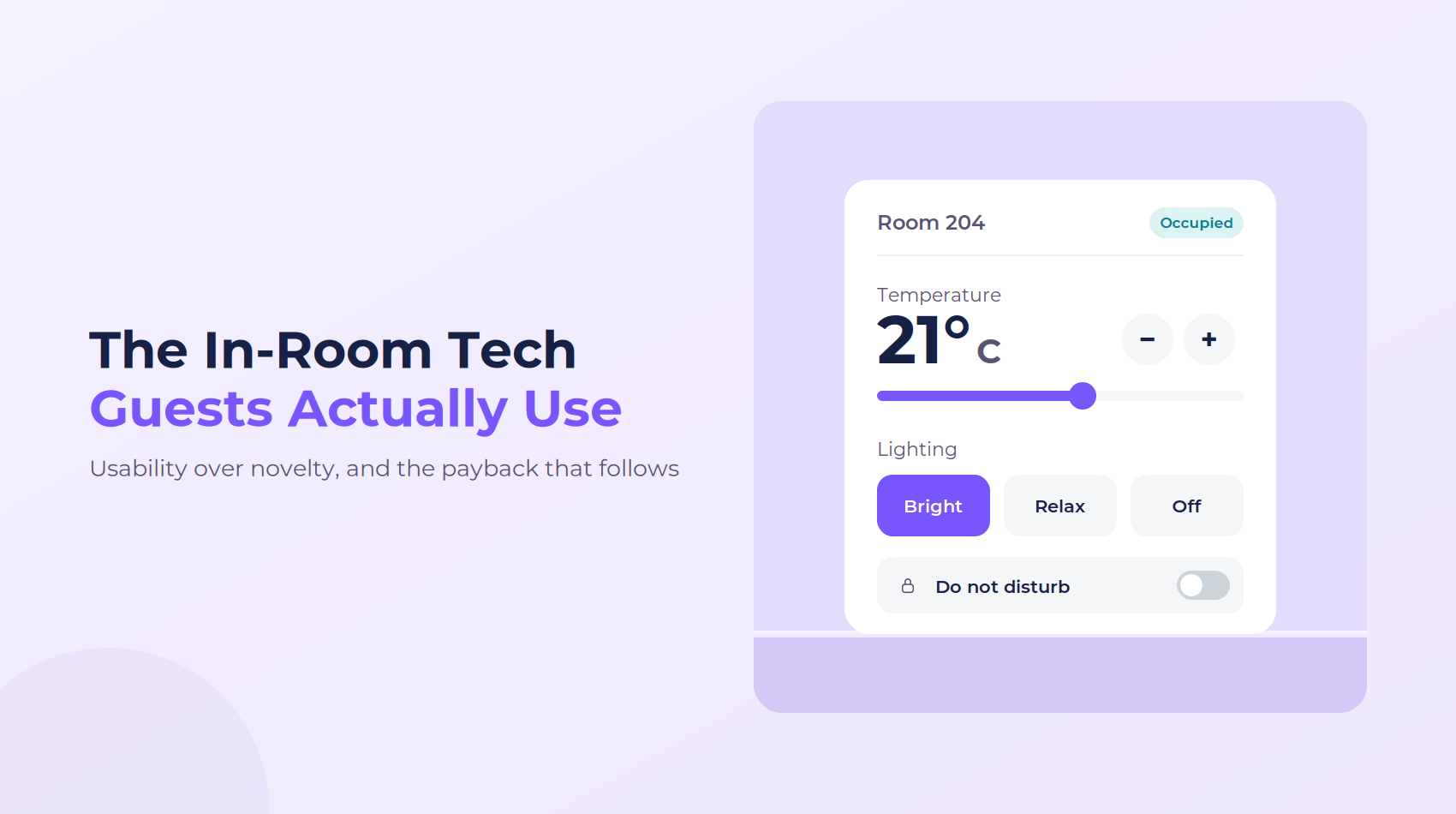
Smart heating controls are automated thermostats. They are usually paired with an occupancy sensor that adjusts room temperature according to whether someone is in the room, or whether the PMS says the room is sold.
This is one of the strongest payback improvements an independent hotel can make. In fact, studies show that smart thermostat controls in hotels can reduce energy usage by up to 40% (Oxmaint, 2026), reflected in thousands of euros of annual energy savings.
What’s better? Smart climate controls save money for the hotel whether the guest notices or not. That being said, automated climate control should mainly manage the hours the guest is not there. For the times that they are in their room, guests should have easy control over their room temperature.
The concept behind smart climate control is simple. A hotel can predetermine a setback temperature, which is a level that a hotel room drops to when it is unoccupied. This is much more effective than shutting and rebooting the heating system every time.
Smart Lighting and Room Controls
Smart lighting systems let you manage and automate the room lights using advanced room controls. These controls are often found as wall panels, mobile apps, voice commands, or even automated sensors.Smart room control panels tend to manage more than just room lights, but temperature, climate, and sound as well.
This is a modern room upgrade that hotels should tread lightly with. As an honest assessment, a tired guest who cannot find their bedside light switch at midnight is not likely to be impressed by an advanced lighting system that supports six scenes. Advanced control panels should remain as intuitive and easy to operate as possible.
A good rule of thumb is to always have a simple, manual backup. An obvious master switch by the door, or a manual bedside lamp switch for easy access. Lighting automation should focus more on parts of a room nobody interacts with, such as corridor, staircase, and bathroom sensors that switch on and off with motion sensors.
The In-Room Screen: TV, Tablet or the Guest's Own Phone
One of the most demanded room technology features in modern hospitality is the smart television. A US based study in 2025 found that up to 40% of respondents marked a smart tv as an essential to their room (JD Power, 2025). This trend is only growing in the European context as well.
The qualities that make a smart TV special is that it allows guests to also watch their own subscriptions (e.g. Netflix, Hulu), cast from their own devices (via Google Chrome or alternatives), or simply hook up an HDMI cable to their laptop to screen share their content. The best part? All of this is just a fraction of the cost of a full IPTV platform.
In-room tablets are another upgrade worth deliberating. While they can centralise information, automate service requests, and replace all printed compendiums, they also do require charging, cleaning, updating and repairing with time. Ultimately, most guests will never really pick one up.
A better alternative is phone integration through a webpage or dedicated app that allows guests to log into the curated hotel guest portals. No need for extra hardware, nothing to clean and repair, and it works seamlessly on the devices the guests already own. This is the easiest and most effective route for a personalised guest experience on a budget.
Guest Wi-Fi: The One That Matters Most
Guest Wi-Fi is without a doubt the in-room technology guests notice and demand most, and the only one that consistently leads to negative reviews when hotels fail to provide it. Whilst a free Wi-Fi may seem like a burdensome hotel cost, no amount of flashy technology can compensate for a guest who cannot join a video call from the room they paid good money for.
Luckily, wide array coverage plans exist to make Wi-Fi costs more feasible. For example, Wi-Fi relays on floors can reduce the need for multiple routers, and can ensure that there is a healthy bandwidth even at full occupancy.
In the end of the day, all smart hotel technologies will rely on internet/bluetooth connectivity, and remains one of the most important pillars of a good guest experience.
Smart Energy Management: Where the Payback Actually Is
Smart energy management in hotels refers to the use of connected devices, automation, and real-time data to optimise and reduce energy consumption in the property without damaging the guest's comfort. This covers a wide array of potential avenues, such as:
- Occupancy based climate control: This is when the climate control system drops to a low cost temperature when a room is not booked, or vacant.
- Setback schedules: This is when the climate control system follows a predetermined schedule that reduces room temperatures based on the time of day.
- Consumption Reports: This is when the connected energy management system works together to compile room by room energy consumption reports, helping the hotel reach a more accurate understanding of setbacks and improvements.
What's even better, calculating the return on investment (ROI) for smart energy controls is something that can be done with confidence. Whilst in room technology is a guest experience investment, smart energy management is a cost investment that can be arithmetically justified.
Within the EU context, sustainable hotel technology is becoming non-negotiable as energy performance laws tighten on poorly performing properties. This means that hotels should view this step as less of an optional saving, and more of a key pillar in a long term strategy for an effective hotel.
Let’s have a look at how the payback period for smart energy controls is calculated.
With our formulas, let’s assume a 40 room hotel that costs €180 per room per year in heating and cooling energy (€7,200 total). Add to that an installed cost of €150 per room (€6,000 total).
| If the reduction is... |
Annual Saving |
Payback Period |
| 10% |
€720 |
8.3 years |
| 20% |
€1,440 |
4.2 years |
| 30% |
€2,160 |
2.8 years |
| 40% |
€2,880 |
2.1 years |
Given that industry estimates predict that an average hotel can reduce energy usage by up to 40%, the payback period for smart energy controls sits at around 2 - 8 years. It’s still best to run this formula with your own energy bills and your quotation to get the most accurate and tailored estimate for your hotel.
Voice Assistants, Privacy and What GDPR Means for In-Room Devices
Placing a microphone in a bedroom is a much harder proposition in Europe than the United States, and most online smart hotel tech guides won’t tell you that. European authorities have taken a rightfully skeptical view on claims that voice assistant tools process audio only for the purpose of fulfilling their role, and have restrictions in place to match that doubt reasonably.
The part that often goes unclarified is who carries the responsibility for managing such data. In this case, the hotel is responsible for what happens in a hotel room, not the device vendor. Whilst a supplier's assurance can be useful, it does not transfer obligation and responsibility.
This is why the better alternative is to rely on mobile based interfaces and in-room tablets, which provide the same convenience without voice command compatibility. For a European independent hotel, this is the most sensible strategy.
Either way, it is a good trust building practice to make sure hotel guests are able to see and understand if any device is present in a room, and if possible, have the option to switch it off.
To help you get the best idea of the tech you bring into your hotel rooms, ask these questions to your potential vendor before signing, and get the answers in writing:
- Where is the data hosted?
- Will you sign a data processing agreement?
- Is guest data used to train any third-party models?
- What is the retention period of collected data, and how is deletion evidenced?
- How does the device reset between guests?
Guest data privacy is a critical pillar of a positive experience, and a legal obligation in the European Union that should not go unnoticed.
Making It Work: Integration and the Housekeeping Reset
The biggest advantage of smart room technology hotels is the performance data about what is happening in the building. Therefore, it’s important to choose systems that don’t just integrate to your hotel, but your hotel management system as well. This includes:
- Property Management System (PMS)
- Revenue Management System (RMS)
- Guest Relationship Management (CRM)
- Booking Engine & Channel Manager
A clear example of how this interconnectivity benefits independent hotels is the check-out trigger. A departure recorded at the front desk can automatically set the climate control back to a low cost temperature in the vacant room and revoke access without any staff lifting a finger.
When that core link is missing, every euro of saving fully depends on staff remembering and acting immediately, which is not only stressful, but means that all savings remain theoretical. This brings us to the housekeeping reset.
The housekeeping reset is a critical step that most guides forget to cover, but is one of the most important habits that need to form in a tech-driven modern hotel. Put simply, any in-room device that retains session data, conversation history, or personal settings from a guest needs to be wiped and reset the moment they depart. Not only is failure to do so a privacy exposure and trust failure, in some contexts, it can even be a crime.
A guest who opens the tablet and finds the last occupant's breakfast order or streaming logins will naturally understand that the room remembers people, and will soon lead to guests wondering what the hotel records and retains about them.
The fix for this is more operational than technical. A reset step belongs inside the housekeeping inspection, with verification, like checking the minibar. The same logic applies to any guest-facing service that requires the usage of personal data, such as housekeeping automation, or contactless payment processing.
Where to Start on a Budget?
It’s understandable that most independent hotels simply cannot front a full refurbishment of their property, nor should they. Our simple priority list below helps to put things into perspective in the most efficient way possible:
Fix First
- Wi-Fi: Aim for healthy coverage in every room, tested at full occupancy rather than averaged across the whole hotel.
- Repairs: Fix anything that is currently broken, confusing or generating complaints (e.g. light switches, faulty taps, old mattresses).
- Television: Bring in smart TV systems that allow guests to watch their own subscriptions, cast, and HDMI connect with ease.
Buy Next (Clear ROI)
- Smart Locks: Clear savings on key cutting, replacements, and repairs, as well as a net advantage for overall hotel security and accessibility.
- Smart Climate Control: The single largest financial savings opportunity, which pays back whether or not guests even notice.
- Hotel App or Website: Optimising the hotel website for a mobile compatible access helps replace the need for in-room tablets, printed guides, and other costly materials.
Optional Improvements
- Voice Assistants:, There is no strong consumer demand for such services, and given the European privacy atmosphere, this improvement is more of a liability.
- Miscellaneous Tech: Scene lighting, smart mirrors, and anything that is beyond a standard, simple improvement or needs learning to operate is not a necessary expense.
When it comes to small hotel management, the priority should always be the immediate guest experience. There is simply no point in spending money on flashy tech, when the basic guest facing services could use improving in the first place.
Smart Hotel Technology: Wrap-Up
The most useful question when it comes to smart hotel technology is quite simple: will this make the guest experience better? And we mean genuinely better. Not everyone wants a hologram projecting mirror that automatically plays music when a guest walks in.
While it may seem daunting to choose the right improvements, the most flashy tech offered by vendors fails to answer this simple question. That's why independent boutique hotels should focus on the essentials:
- A working, accessible Wi-Fi connection.
- A secure, cardless door lock system.
- Full mobile accessibility for hotel information sources.
- A television that allows guests to stream and connect to their own media.
Everything beyond this should justify itself before it gets a line in the budget.
Why Noovy?
Noovy does not sell locks, thermostats or tablets. What we provide is the layer underneath them: the system that knows which rooms are sold, who has arrived, and who has just left.
- A PMS as the source of truth. Occupancy, arrival, departure and room status are what turn climate setback and access controls into automatic jobs. Without that, in-room technology depends on somebody remembering, eliminating the purpose of it.
- Open integration rather than closed loops. The practical requirement for a property running three products from three suppliers.
- One guest record. Guest preferences are available where they are needed, and when they are needed, all GDPR compliant.
Ready to take your hotel to the next level? See how a connected PMS makes in-room technology work without adding to your team's workload. Book a free demo today!