Establishing how hotels measure guest satisfaction helps transform your business from a “gut feeling” operation to an efficient hotel with data-driven improvements. Guest satisfaction data helps preemptively improve hotel shortcomings before they become service failures in the eyes of your guests.
For the independent hotelier, measuring guest satisfaction can feel like a complex challenge, but an integrated hotel booking engine and CRM can centralise data from the moment a guest arrives to the check-out and post-stay follow-up. With data, measuring guest satisfaction comes down to clear formulas and actionable conclusions.
Ever wondered, how do hotels measure guest satisfaction? This tactical guide will provide everything you need to know for quantifying guest sentiment, moving beyond vague feedback, and automating data collection to identify trends and friction points with ease.
Ready to improve your guest understanding? Book a free demo with a Noovy expert today and discover world class guest tools to boost your hotel performance.
Table of Contents
What is Guest Satisfaction in Hotels?
Why Hotels Should Measure Guest Satisfaction
Guest Satisfaction Metrics: CSAT, NPS, and CES
Alternative Methods for Measuring Hotel Guest Satisfaction
Measuring Guest Satisfaction: Wrap-Up
Frequently Asked Questions
What is Guest Satisfaction in Hotels?
Guest satisfaction in hospitality is a method of understanding the difference between guest expectations and lived experience when interacting with your business. If experiences fall short of expectations, it might indicate room for improvement in the hotel.
Guest satisfaction is a technical KPI with the goal of identifying service friction before it becomes a problem. This data helps independent hotels predict their business performance and identify room for improvement through real time feedback loops. Guest satisfaction measures can cover the full range of guest touchpoints, such as the ease of booking, checking in and out, room comfort, quality of services, and much more.
With modern hotel technology, gathering guest data has never been easier. By quantifying sentiment through a PMS and CRM, hotels can automate data collection and reporting, making it simple to draw preemptive conclusions on what works and what doesn't.
Why Hotels Should Measure Guest Satisfaction
For independent hoteliers, measuring guest satisfaction in hotels is the most effective way to understand clients and their needs during the guest experience journey. Without a formal measurement system in place, many boutique hotels are left relying on guesswork and reactive management, often causing a data vacuum where the only voices a hotel hears are the loudest (and often angriest).
Beyond clarity between businesses and their clients, here are some key advantages that highlight the importance of guest satisfaction tracking:
- Higher RevPAR: Guest satisfaction in hotels is a leading indicator of financial performance. Hotels in the upper quartile for guest satisfaction scores almost always enjoy a higher average daily rate (ADR) because their reputation reduces the perceived risk of disappointment for the traveller.
- Efficient Improvements: Measuring guest satisfaction enables your hotel to identify departmental failures before they become a disaster. For example, if your overall guest satisfaction is high but many guests are dissatisfied with your breakfast, then you know to direct resources to improve that specific function.
- Better Guest Recovery: Guests who experience disappointment that was resolved quickly and professionally often become more loyal than guests who experienced no issue at all. Measuring satisfaction in real-time gives your hotel a chance to solve issues preemptively, instead of receiving negative reviews after a guest checks out.
Guest Satisfaction Metrics: CSAT, NPS, and CES
There are several popular methods for quantifying guest satisfaction in hotels and drawing conclusions from the results. However, not all feedback serves the same purpose, so using the wrong metric or formula for the wrong department can lead to skewed results.
Here’s a breakdown of popular guest satisfaction metrics to help you refine your guest communication strategy:
CSAT (Customer Satisfaction Score)
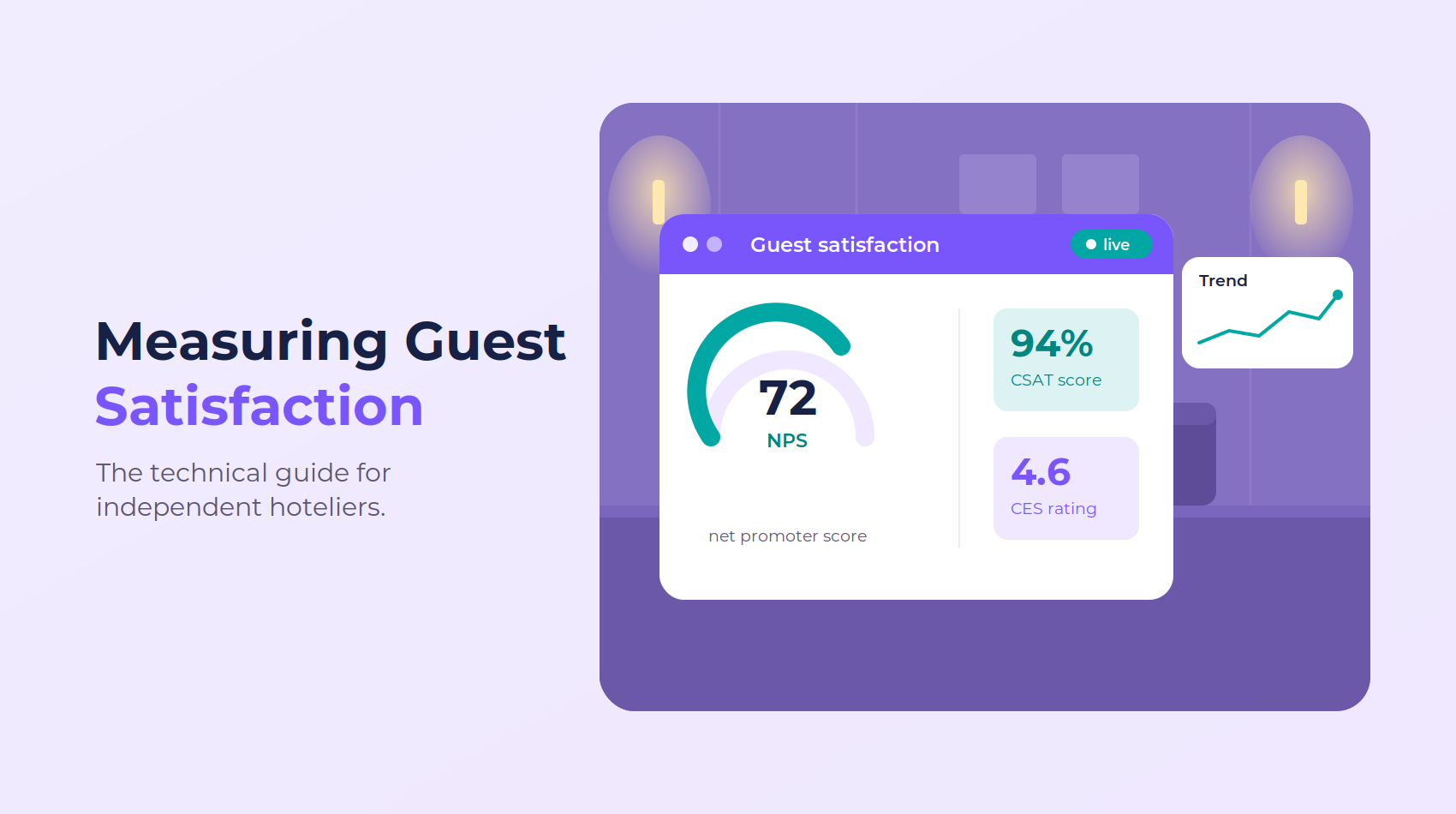
A Customer Satisfaction Score (CSAT) is a key performance indicator that measures a guest's short-term satisfaction with a service. It’s typically calculated as a percentage (0 - 100%) based on survey responses that ask customers to rate their experience.
Typically, the scale is a linear numerical scale (e.g. 1 - 10) and asks a series of hotel guest satisfaction survey questions such as “How happy were you with the check-in process?”.
CSAT scores are one of the easier methods to gauge real time guest satisfaction in hotels. To make sure survey responses are collected efficiently, here’s a suggested workflow:
- Send Survey: Send an automated guest satisfaction survey invite via SMS or email 30 minutes after a specific service in your hotel (e.g., a spa treatment or dinner).
- Filter Negatives: Filter scores below a 7 to trigger an immediate alert to the head of department so that they can be addressed before the guest leaves the hotel.
- Make Improvements: By averaging your guest satisfaction scores, you can identify what went well, and what needs improvement and departmental training.
NPS (Net Promoter Score)
A Net Promoter Score (NPS) is a guest experience score for long-term loyalty. It tries to understand the extent to which guests are happy with the service they received. It does so by measuring how likely guests are to recommend your hotel to others.
An NPS is calculated by subtracting the percentage of detractors (0 - 6) from the percentage of promoters (9 - 10). Guest satisfaction scores range from -100 to +100 and represent hotel reputation and potential customer retention.
The NPS metric is important for several reasons. Not only does it tell you the percentage of guests that can potentially be loyal to your hotel, but it also identifies the guests who can be promoters of your hotel through positive word of mouth.
CES (Customer Effort Score)
A Customer Effort Score (CES) is a metric that measures the ease of interaction a guest experiences with your services. Convenience is measured on a numerical scale (e.g. 1 - 5) and a final score is calculated by either averaging the total scores, or calculating the percentage of positive responses.
CES scores are very important as guest effort is one of the greatest predictors of future disloyalty. If a guest has to work too hard to access or enjoy your amenities (e.g. complicated WiFi password, breakfast service takes too long), their satisfaction will drop significantly.
Alternative Methods for Measuring Hotel Guest Satisfaction
Beyond more established metrics and guest satisfaction questionnaires, independent hotels can adopt a range of multi-channel methods to understand the full scope of their guest satisfaction. Let’s take a look at some low-cost efficient methods.
SMS Pulse Checks for Real-Time Guest Feedback
The most difficult guest feedback to address is a post-stay negative review. When a guest has a bad experience and only chooses to share it after leaving, it’s no longer possible for your hotel to mend the situation in real time.
To prevent this from occurring, guest sentiment should be constantly checked while the guest is still on the property. Short SMS pulse reviews automated by your CRM are a great way to do so without overwhelming your guests.
Here’s our suggested workflow to get you started; designed to be applicable to all your departments:
- Send Review: Your CRM identifies a guest who has arrived. Two hours after their keycard is activated, the CRM automates an SMS: "Is your room as you expected?".
- Filter Response: If the response is "No", the system triggers a second automated question: "We’re sorry to hear that. What can we fix for you right now?".
- Address Issue: The "No" response automatically generates a high-priority task in your housekeeping or maintenance dashboard, alerting the duty manager immediately.
By keeping a close check on guest satisfaction throughout their stay, you can ensure that dissatisfaction is addressed proactively, reducing the likelihood of negative reviews.
Social Media
A well-managed social media page acts as a live focus group. External social tracking tools help identify brand mentions and tags, polls can gauge the sentiments of your viewers, and posts can be made to market promotions.
There are many ways in which social media can grow a hotel online, but let's focus on its role with measuring hotel guest satisfaction through active and passive means:
- Active Measurement: Features like Instagram Polls or "Ask Me Anything" stickers are active invites to your audience, designed to gauge their sentiment on various topics (e.g., "Which new cocktail should we add to the summer menu?").
- Passive Measurement: By monitoring the user-generated content (UGC) associated with your hotel (tags, mentions, holiday recaps), a hotel can see how its guests are actually using their spaces versus how you intended them to be used.
Review Sites as Guest Satisfaction Data
Review sites are a treasure trove of data on guest sentiment. Sites like TripAdvisor, and Yelp act as a public performance audit for independent hoteliers. The only difference from guest satisfaction measurements is that the data is unstructured and needs organising.
Here’s how an independent hotel can do just that:
- Collect: Noovy’s unified PMS, CRM, and booking engine work together to create a unified inbox, which can then pull all OTA reviews into a single dashboard.
- Categorise: Collected reviews can then be categorised by guest type, purpose, or activity (e.g. family, business) to see where your property over or underperforms.
- Benchmark: Your hotel's market-quality power can then be tracked by comparing your average rating against your primary local competitors.
AI Sentiment Analysis for Hotel Reviews
For a boutique hotel with a lean team, manually analysing every comment a hotel gets is simply impossible. AI Sentiment Analysis and Natural Language Processing (NLP) are highly effective low-cost methods for organising large amounts of data automatically.
AI tools can organise data by identifying and categorising keywords that carry an emotional indicator with them. For example, the keyword “awful” will almost always be associated with a negative sentiment whereas “amazing” will almost always suggest something positive.
This approach helps track sentiment velocity; the speed at which public opinion about your hotel changes and develops over time. Let’s say the keyword "slow" suddenly begins appearing in relation to "breakfast" reviews. The AI can identify this trend and flag a department member to address the issue before it impacts your hotel's rating.
Measuring Guest Satisfaction: Wrap-Up
Guest satisfaction in the hotel industry is a vital component of any successful venture. It’s a technical advantage that helps hotels move away from reactive management towards a more intentional and predictive service that is informed by guest data.
By implementing the big three metrics (NPS, CSAT, CES) alongside alternative methods, your hotel can develop an accurate oversight of what goes well and what needs improvement before it hits the public internet.
Also, automating feedback loops helps your hotel create a self-correcting business model, where your staff is always one step ahead of guest needs.
Why Noovy?
Wondering how to improve guest satisfaction? Noovy’s state-of-the-art tech stack is designed to empower independent hotels to deliver top services at a fraction of big resort costs.
Noovy’s CRM and Automated Feedback Engine are designed to foster oversight and accountability over the entire guest satisfaction management process. Unlike standalone survey tools, Noovy’s automation tools enable context-aware surveys to be generated and distributed with no human intervention.
What's better? Since Noovy’s CRM is natively integrated with our hotel booking engine, your system will know exactly who the guest is and what they value:
- Corporate Travelers: Noovy’s CRM prioritises guest satisfaction survey questions that gauge Wi-Fi stability, hotel breakfast and lunch speed, desk space and more.
- Families: The system focuses on CSAT metrics for relevant amenities such as rest areas, kids clubs, and dining facilities.
- Solo Travelers: Noovy’s CRM pulls all OTA reviews into a single dashboard to organise per guest and make it easier to reach sentiment conclusions.
Ready to eliminate guesswork and master your guest relationships? Book a free demo of Noovy’s hotelier tech stack today!