Sustainable tourism has quickly evolved from a niche alternative into a mainstream travel priority. Driven by increasing awareness around environmental issues, modern travellers are likely to seek authentic, low-impact holiday experiences and hold the hospitality sector accountable for structural action towards conservation.
For independent hotels, high guest expectations can feel exhausting to keep up with when managing a small budget and team. Beyond arrivals, coordinating schedules, and retaining staff, environmental compliance paperwork is rarely on the top of the priority list.
Still, eco-certification is a very effective business strategy. By adopting green hotel technologies and improving resource consumption, hotels protect themselves from heavy bills while positioning a brand that captures eco-conscious travellers.
This ultimate guide to eco-certifications will show you the criteria of top eco-certifications in hospitality, and how it can lead hotels towards a smarter, and more profitable future.
Ready to upgrade your software to a leaner, greener alternative? Book a free demo with a Noovy expert today and get acquainted with our modern hotelier tech stack!
Table of Contents
Why Does a Sustainability Certification Matter for Modern Hotels?
Modern travellers are highly informed consumers who actively search for accommodation options that match their personal values. As a result, there is a rising demand for sustainability to be an integral part of the hotel guest experience. This demand has led online travel agencies (OTAs) and search engines to restructure how hotels are marketed to the public.
Major OTAs like Booking.com and search tools like Google Travel now feature specialised search filters and badges to highlight certified sustainability hotels. If a property lacks a verified sustainability certification, it’s excluded from these filtered search results, missing out on a massive pool of high-intent bookings.
Corporate travel managers are also increasingly bound by strict environmental, social, and governance (ESG) mandates. When corporate accounts or group event planners vet independent hotels for business stays, they frequently require proof of third-party environmental validation. Holding a recognised green credential is often a strong deciding factor that allows hotels to access these highly lucrative contracts.
Top 5 Eco-Accreditation Frameworks for Hotels
Navigating the countless international sustainability labels can easily lead to confusion. To make an informed choice, independent hoteliers must understand which sustainability label offers the right fit for their property type, carbon footprint, and business scale.
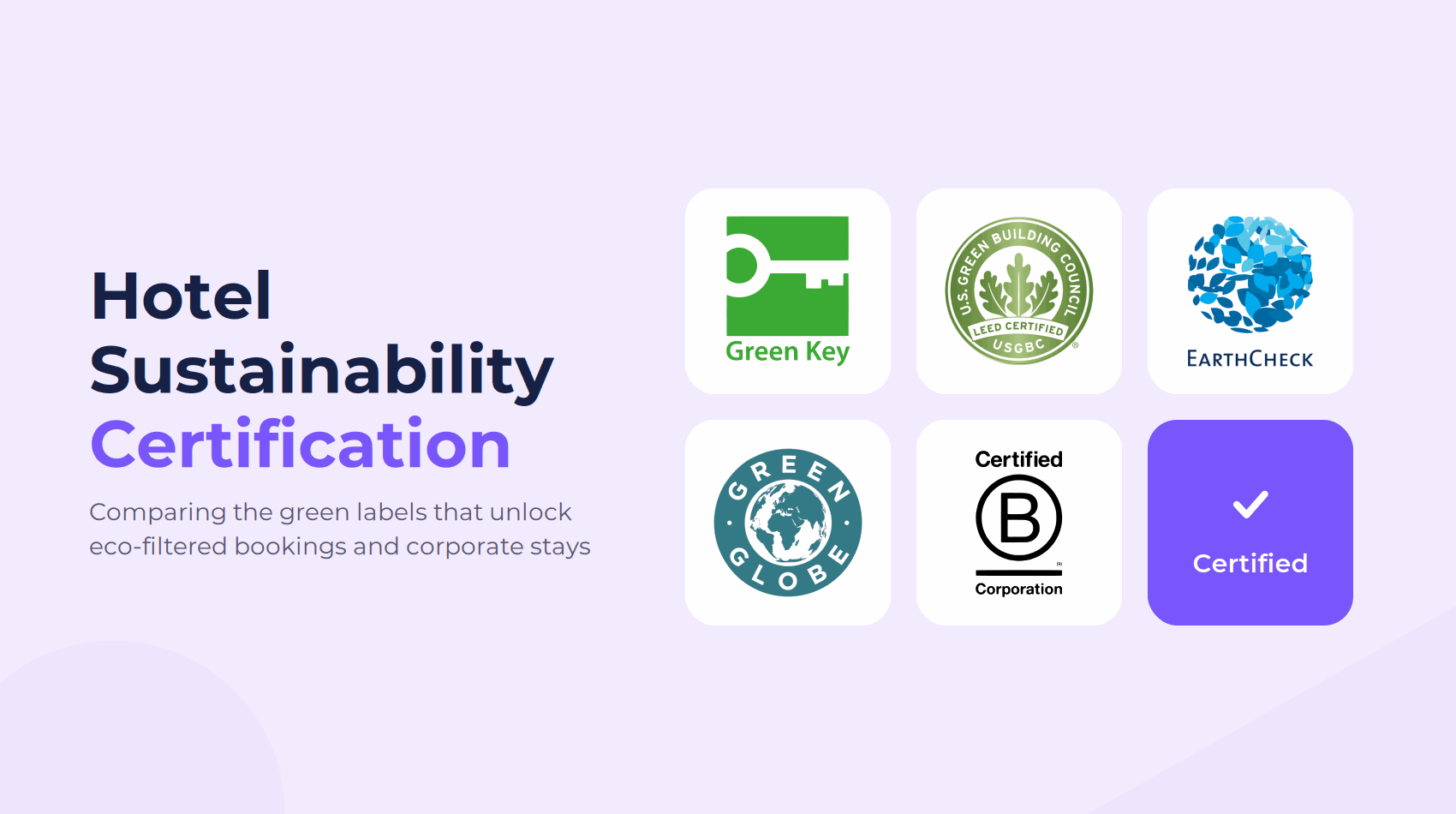
Here’s an objective review of the top five global sustainability frameworks, highlighting their specific values to independent hotels:
Green Key
The Green Key global hotel certification program is widely recognised as a leading international hospitality eco-label. Managed globally by the Foundation for Environmental Education (FEE) and operated locally in England by Keep Britain Tidy, it’s built explicitly to cater to hospitality operations, such as:
- Hotels and hostels
- Campsites and holiday parks
- Restaurants and conference centres
- Attractions and museums
To earn a Green Key certificate, hotels need to show strict adherence to standards across more than 100 criteria, mainly in the areas of:
- Environmental Management: Policies, staff training, and guest communication.
- Resource Conservation: Water and energy efficiency (e.g., LED lighting, low-flow fixtures, smart thermostats).
- Waste Management: Reduction, recycling, and elimination of single-use plastics.
- Green Operations: Sustainable food and beverage choices, eco-friendly cleaning products, and green landscaping.
- Community Engagement: Sourcing locally and supporting social responsibility.
| Suited For |
Value |
|
Perfect for independent boutique hotels that want a highly respected, sector-specific framework. Because its criteria target everyday hospitality tasks—like kitchen waste management, linen cleaning loops, and guest education—it blends easily into a property's routine without requiring structural real estate alterations.
|
Provides an immediate global recognition in sustainability action and automatically syncs with major OTA green search filters on web platforms and tourism boards. |
To apply for the Green Key sustainability accreditation, hotels can reach out to their nearest operator, or apply directly via the web. The official Green Key website also contains information on the qualifying criteria, on-site audit, and decision making process.
LEED (Leadership in Energy and Environmental Design)
LEED is one of the world's most widely used green building rating systems. Developed by the U.S. Green Building Council (USGBC), this certification provides a globally recognised framework for designing, constructing, and operating cost-saving green buildings.
To earn a LEED certification, a hotel must accumulate points across several key areas of environmental and human health:
- Energy & Atmosphere: Efficiency, energy performance, and renewable energy use.
- Water Efficiency: Indoor and outdoor water reduction.
- Materials & Resources: Use of sustainable, eco-friendly, and recyclable building materials.
- Indoor Environmental Quality: Air quality, access to natural light, and thermal comfort.
- Location & Transportation: Proximity to public transit and smart site development.
Its UK equivalent, BREEAM (Building Research Establishment Environmental Assessment Method), functions the same, focusing heavily on the hotel itself as a physical asset.
| Suited For |
Value |
| Best for independent owners who are developing a new property, undergoing major structural renovations, or completing a historic building retrofit. These frameworks evaluate structural items like insulation ratings, solar panel connectivity, and advanced HVAC efficiency. |
While achieving this green hotel certification involves a detailed architectural review, it greatly maximises the long-term asset value of the property, permanently lowering building energy demands, making it more attractive on the property market. |
To apply, hotels must follow a points-based assessment of their property. The process is handled through the USGBC and the Green Business Certification Inc. (GBCI), depending on whether a hotel is certifying its building project or earning an individual credential
EarthCheck
EarthCheck is a highly scientific, data-driven benchmarking and certification program fully accredited by the Global Sustainable Tourism Council (GSTC). It helps hotels, tour operators, and tourism destinations measure their environmental footprint, reduce operational costs, and manage their social and economic impact.
Certified hotels and hospitality businesses are required to track, report, and improve on key indicators, including:
- Energy and water consumption
- Greenhouse gas emissions and carbon footprint
- Waste management and paper use
- Use of chemicals and pesticides
- Community engagement and employee fair-wage policies
| Suited For |
Value |
| Ideal for data-driven operators who want to measure every single ounce of carbon, waste, and water usage with absolute precision. EarthCheck uses rigorous software monitoring to compare your hotel’s performance against regional industry averages. |
Holding this premium sustainability accreditation proves to corporate compliance officers and institutional investors that your property's environmental metrics are fully verified and backed by data. |
Hotels have a choice between the EarthCheck ECO for small businesses, or the advanced EarthCheck Certified program. The process follows several steps, including an initial commitment, data collection, benchmarking, and third-party verification.
Green Globe
The Green Globe is an internationally recognised sustainability certification for the travel, tourism, and hospitality industry. It verifies that businesses operate at certain environmental, social, and economic standards by evaluating hotels based on 44 core criteria, based on the four key pillars:
- Sustainable Management: Establishing long-term sustainability management systems and staff training.
- Social & Economic Well-Being: Supporting local employment, fair-trade purchasing, and community development.
- Cultural Heritage: Respecting local historical sites, traditions, and artefacts.
- Environmental Responsibility: Conserving energy and water, reducing waste, and protecting biodiversity.
| Suited For |
Value |
| Excellent for properties that want to prove their dedication to sustainable supply chains and ethical local sourcing. |
Ensures that your entire operational network (e.g. coffee suppliers, or local laundry vendors) operates sustainably, protecting your brand from greenwashing. |
Green Globe goes through a stringent process to prevent greenwashing. The application process follows registration as a member, an evaluation of the criteria and expected sustainability standards, followed by a formal on-site audit.
B Corp Certification
B Corp is a uniquely thorough global accreditation service that evaluates an entire business rather than just its carbon footprint. It does so by assessing a broad range of concerns, such as social and environmental performance, public transparency, and legal accountability.
Unlike traditional eco-labels, B Corp looks at a company's entire operational impact across five core areas:
- Governance
- Workers
- Community
- Customers
- The Environment
| Suited For |
Value |
|
Highly recommended for modern, lifestyle-driven independent hotel groups looking to connect with younger demographic shifts. Innovative European hospitality brands use their B Corp status as a foundational part of their brand identity.
|
It positions hotels as a progressive, purpose-driven workplace, which serves as a powerful talent acquisition asset during competitive hospitality recruitment phases. |
To apply for the B Corp, hotels can visit the B Impact Platform to complete a self-assessment. This is followed by B Impact Assessment (BIA), a formal audit, and certification.
The Business Case for Sustainability in Hotels
Independent hoteliers are often concerned with the upfront cost of audit fees and green upgrades. However, analysing the financial numbers proves that investing in sustainability in hotels delivers a clear return on investment (ROI).
When properties comply with verified eco-benchmarks, they are inherently eliminating resource waste from their own profit and loss statements. Here’s how that looks:
- Less Utility Use: By upgrading energy and water access with efficient tools (e.g., smart HVAC, LED retrofits, and automatic water taps), a hotel can reduce annual utility costs by 10 - 35% in just the first year (Marriott, 2025).
- Less Waste Production: Throughout European independent hotels, up to 21% of daily waste production are food ingredients that have spoiled (European Cluster Collaboration Platform, 2026). Integrating AI driven inventory trackers and comprehensive recycling can slash waste disposal costs by 50%.
- Improved Property Value: The energy crisis affects more than just hotels. As a result, modern properties with key energy efficiency measures are valued higher on the market, often seeing up to 23% in value uplifts (Marriott, 2025).
- Better Grant Access: Green bonds and sustainability loans provided by grants, investment banks, and development funds are easier to access as major investors prioritise hotels with strong environmental, social, and governance (ESG) profiles.
- Higher Net Revenue: Studies suggest that up to 50% of tourists are willing to pay more when a hotel can offer verified sustainable accreditations to back their status as a sustainable hotel (MDPI, 2023). This can lead to higher hotel net profit.
In addition, several countries and unions even provide government backed grants for properties planning or legally required to improve their energy efficiency.
How to Choose the Right Eco Hotel Certification
A hotel doesn’t need to rewrite its entire operational manual overnight just to secure an eco hotel certification. The best approach is to follow a structured plan that helps map out exactly how to get green hotel certification without disrupting daily guest services:
- Conduct an Initial Audit: Before committing to an official audit, hotels should first understand their current resource footprint. Keeping 12 months of utility invoices, waste removal statements, and chemical procurement logs neatly organised gives auditors a clear benchmark to evaluate and speeds up the verification timeline.
- Review the Supply Chain: Auditing hotel vendors can help identify operational shortcomings. Single use shampoo bottles should be replaced with refillable bulk dispensers. Local agricultural partners can replace internationally sourced food and beverage chains. Kitchens can adopt seasonal menus.
- Become a Paperless Hotel: One of the most impactful ways to meet environmental standards is to remove physical paper from the check-in and check-out process. By digitising the process, hotels can eliminate printed registration slips, paper folios, and housekeeping clipboards that immediately reduce a hotel's physical waste metrics.
Hotel Eco-Certifications: Wrap-Up
Long term sustainability isn’t about working harder or throwing money at the problem. True sustainability is only a net positive for a hotel's bottom line, efficiency, and brand image. By building smarter, tech-driven workflows to replace outdated processes, hoteliers can easily meet environmental criteria while creating an exceptionally smooth, professional guest experience.
An eco hotel certificate is a testament to a sustainable hotel business model that takes into consideration the guests, the community, and the environment at large. In modern hospitality, this goes a long way to fostering guest loyalty and repeat business.
Why Noovy?
Noovy is entirely designed to support independent hoteliers with a green transition. Our completely cloud-native property management platform helps hotels cut down paper waste by digitising the entire guest journey, offering seamless web check-ins, automated registration cards, and electronic billing folios straight to a guest's smartphone.
Here are just some of the ways we help you hit those eco-certification criteria:
Furthermore, Noovy’s intuitive UI and centralised dashboards aggregate performance data into neat data reports, making tracking easier than ever. Assess your daily utility usage and occupancy patterns against the metrics you need to ace your next green certification review.
Ready to embrace a greener future? Book a free demo with a Noovy expert today, and become acquainted with our state of the art hotelier tech stack!