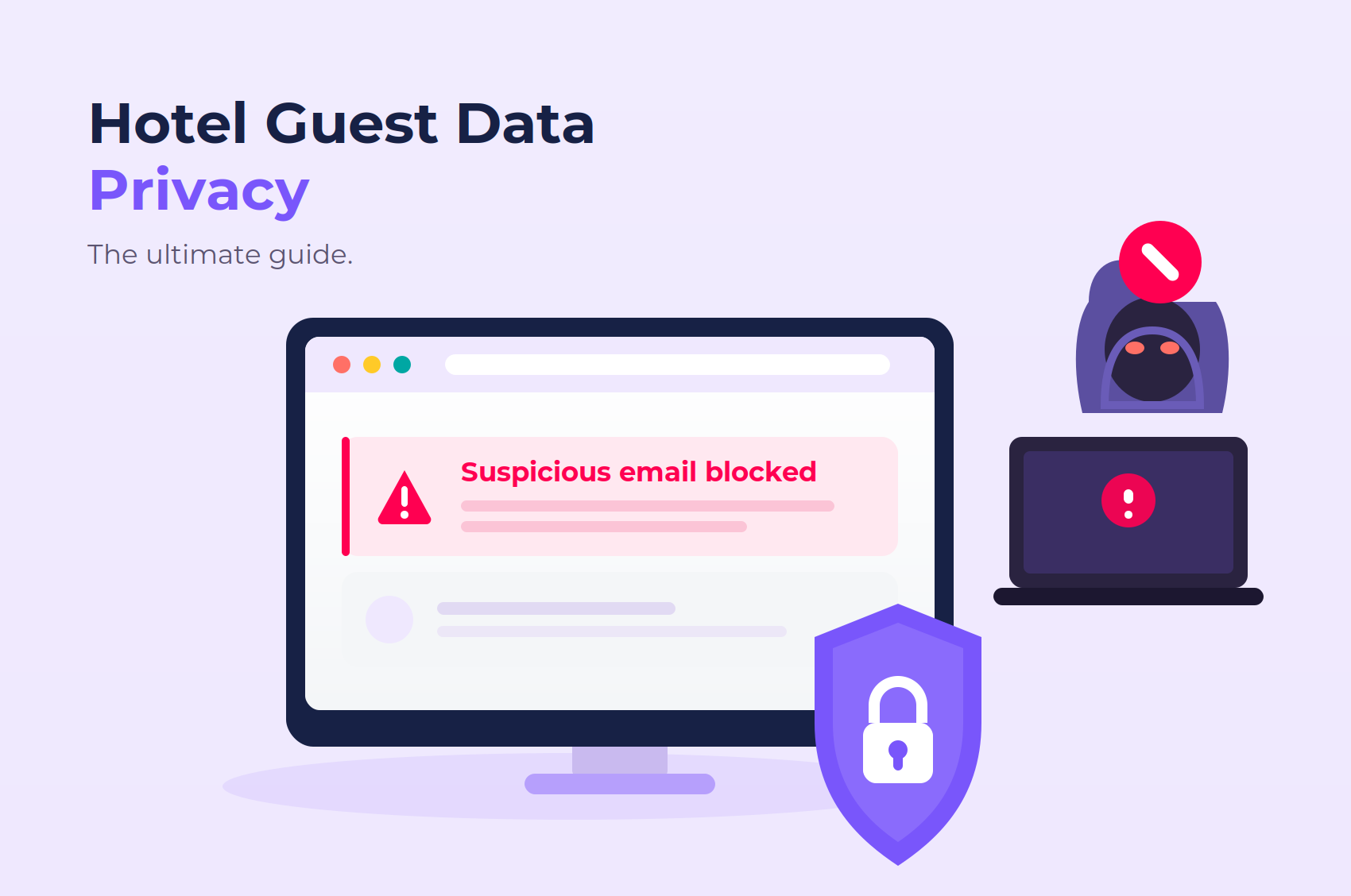
When thinking of guest safety, hoteliers tend to focus on physical safeguards such as on-site security, door locks, and lobby surveillance. However, the modern digital environment requires a structural barrier for a newer, more sinister risk: digital security.
Today's highest-stake, most vulnerable asset for data thieves is the guest’s digital identities. The moment a traveler inputs their full name, address, passport and credit card information into a hotel's system, that hotel now carries responsibility over their security. With 2026 world tourism figures projected to reach a record-breaking 1.54 billion, digital security has never been more important (UN Tourism, 2026).
A part of forming a positive guest relationship is also ensuring that a hotel takes every expected measure to keep personal guest information and financial records secure. Every guest is entitled to hotel guest privacy rights, and no guest can feel genuinely comfortable if their details are sitting exposed on a sticky note or front desk computer.
This ultimate guide details how the modern guest security landscape has shifted, guiding hotels on how to modernise digital security architectures, satisfy international regulatory frameworks, and protect guest profiles from emerging digital threats.
Ready to boost your hotel data security? Book a free demo with a Noovy expert today and get acquainted with our state of the art data protection mechanisms.
Table of Contents
The Digital Shift in Hotel Cyber Security
Navigating International Hotel Guest Privacy Laws and Compliance
Data Loss Prevention in Hospitality: Securing the Guest Journey
Hotel Guest Security: Wrap-Up
Frequently Asked Questions
The Digital Shift in Hotel Cyber Security
Independent hotels are major targets for digital exploitation. Many hoteliers mistakenly assume that hackers only target corporate mega chains. In reality, smaller boutiques are frequent victims due to simple digital barriers that are historically easier to breach.
In March 2026, European accommodation platforms like CheckIn and Gastrodat were hit with a data breach that leaked the data of over 5 million guests (All Inclusive, 2026). In June, a similar data breach leaked personal guest information stored in a further 100 independent hotels throughout the Netherlands (DutchNews, 2026).
Hotel data breaches rarely begin with an intruder entering your desktop. Instead, hackers find access through silent openings such as unencrypted networks, open Wi-Fi networks, and exposed terminal screens. Furthermore, customer data that is scattered across spreadsheets, registration books, and outdated servers is at an immense risk.
To safeguard a hotel business and its guests, the digital infrastructure must be built inside a secure, centralised, and monitored cloud framework.
Navigating International Hotel Guest Privacy Laws and Compliance
International regulation mechanisms provide legal reasons for hotels to upgrade their properties' digital security. These compliance criteria are international in nature, enforced under the European Union's General Data Protection Regulation (GDPR) framework.
Navigating international hotel guest privacy laws requires independent hoteliers to build core operational systems around three hotel GDPR compliance pillars:
- Data Minimisation: Hotels should only collect, store, and process guest details that are strictly necessary to complete a reservation or satisfy legal registration rules.
- Explicit Consent: Marketing communications must be completely opt-in, and cannot be mandatory. Pre-checked boxes on reservation screens or registration documents do not meet modern compliance standards.
- Right to Erasure: Hoteliers must maintain clean, organised data stores that allow them to permanently delete a past guest's historical profile if requested, provided it does not conflict with local tax or police record-keeping laws.
Failing to meet these standards risks massive financial penalties, with major regulatory frameworks establishing fines that can reach up to 4% of a business's annual revenue. Hotels can use this GDPR hotel checklist to ensure core responsibilities are met.
Data Loss Prevention in Hospitality: Securing the Guest Journey
To safeguard both guest data and brand reputation, hotels need to implement formal, transparent systems for data loss prevention. Instead of a risky, reactive security approach that waits for a problem to resolve, a secure hotel requires a comprehensive understanding of how guest data travels through the hotel in the first place.
To help independent hoteliers evaluate their specific vulnerabilities, there are three distinct operational areas that require the most focus:
Eliminating Unsecured Data Trails
The most vulnerable avenue in independent hotels is scores of raw, unencrypted personal records. Credit card numbers, passport copies, transaction histories, and paper invoices that sit in files and cabinets pose a massive liability for a hotel's security. Security breaches, whether physical or digital, happen when these data trails are left exposed.
A modern approach to data security in a hotel requires guest identity collection through encrypted, digital interfaces, such as secure digital check-ins that instantly eliminate paper clutter. Most high-quality modern tech vendors provide cloud-based hotel management software with such security protocols.
Create Local System Access Control
Unauthorised access, driven by human error and system vulnerabilities, is the leading cause of data breaches in hospitality (Verizon, 2026). To fix this, a secure hotel guest policy requires strict user permissions within the property management system (PMS).
For example, the front desk member may need access to a guest's room assignment, requests, and preferences, but they don’t need access to financial records or payment details. Restricting backend access within the team ensures that sensitive data is only visible to authorised personnel, and only during operational workflows that require accessing such data.
Relying on End-to-End Cloud Encryption
On-site hotel servers are highly vulnerable to physical theft, hardware crashes, and digital intrusions, all of which can lead to compromised, corrupted, or lost guest data.
True DLP in hospitality (data loss prevention) relies on shifting data management into enterprise-grade cloud software, ensuring that every piece of information collected is continuously encrypted, securely backed up, and protected by dedicated remote security teams. That way, the hotel no longer carries physical copies of any data.
Hotel Guest Security: Wrap-Up
Delivering a positive hotel guest experience relies on a balance between accessibility and security. While the physical lobby, dining spaces, and guest rooms should feel open, warm, and safe, the backend data operations must remain just as secure.
Here’s why transitioning to a cloud-based digital ecosystem is a net positive for data security:
| Service |
Legacy Server |
Cloud Ecosystem |
| Payment Card Handling |
Raw card digits manually typed into plain text fields. |
Point-to-point tokenisation via secure payment gateways. |
| Identity Management |
Printed registration card and passport copies stored in physical folders. |
Encrypted digital check-in logs with automated access controls. |
| Compliance Maintenance |
Expensive manual software patches made, just to meet new law requirements. |
Continuous, automatic cloud-level compliance upgrades, at no extra charge. |
| Data Architecture |
Disconnected data silos across separate, isolated systems. |
One unified, heavily encrypted cloud database across the entire hotel operation. |
Why Noovy?
Noovy acts as a secure cloud-based foundation for the modern, independent hotelier:
- Cloud Based Storage: Built from the ground up to eliminate local data risks, Noovy shifts a hotel's data infrastructure away from vulnerable local hardware into a secure cloud ecosystem.
- Digital Workflows: Noovy replaces high-risk paper processes with an integrated, paperless, digital workflow that captures guest profiles safely and accurately.
- Secure Payments: The Noovy system utilises point-to-point tokenisation and full contactless payment, ensuring that raw payment card details never enter or sit exposed inside a hotel's local network.
With built-in features explicitly engineered to simplify international data compliance, Noovy provides independent operators with total peace of mind, allowing hotels to focus on delivering world-class guest service while knowing their property's digital footprint is completely secure.
Frequently Asked Questions