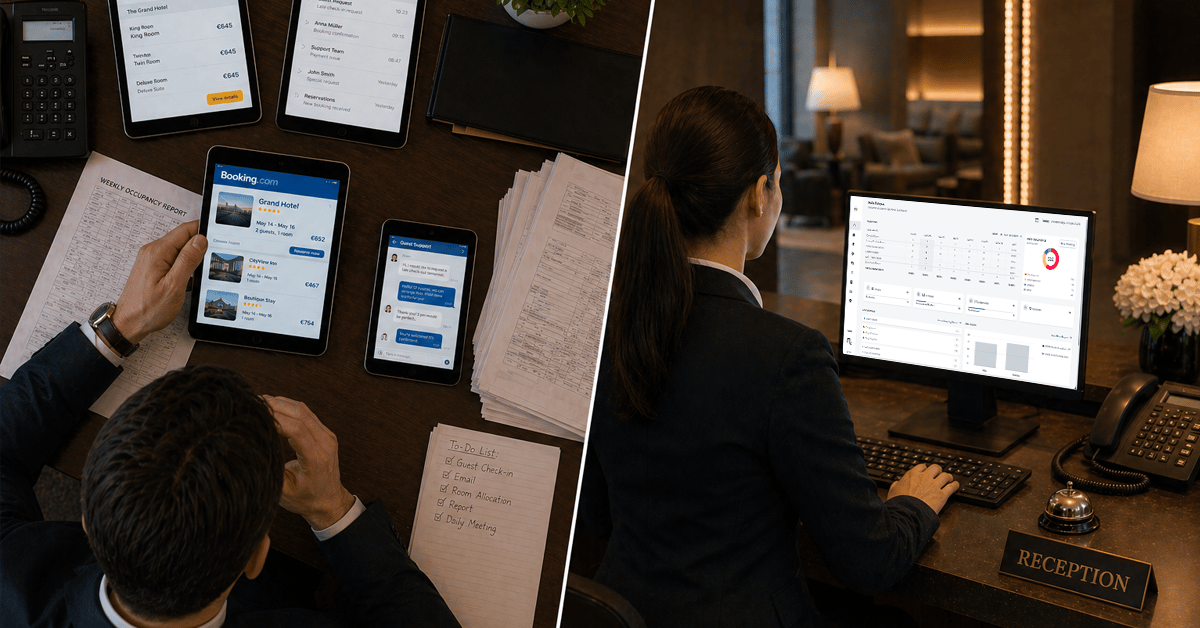
For independent hotels with manual communication systems, the daily reality is often a fragmented nightmare. Noise complaints on chat, late OTA check-ins with encrypted emails, breakfast allergies tracked in a physical logbook; all of this leads to silos of isolated data, frustrated guests, and fatigued staff that always feel one step behind.
Guest Relationship Management Systems (CRM) are the primary solution for this communication leak that plague independent hoteliers today. Providing a central hub for guest data, CRM ensures that no piece of guest data goes unnoticed.
Wondering how CRM improves guest communication in hotels? This tactical guide provides a roadmap for centralising your communication channels. You’ll learn hotel guest communication tips, including how to automate the routine parts of a guest journey while ensuring that every digital interaction is efficiently rooted in their needs.
Ready to upgrade your guest communications? Book a free demo of Noovy's unified hotel CRM today and see for yourself why we’re the independent hoteliers best friend.
Table of Contents
What is Hotel CRM Guest Communication ?
Unlike customer relationship management systems used in sales and marketing, hospitality CRM systems are specialised to unify every digital touchpoint of a guest's timeline. In short, your CRM system is the brain of your hotel's guest interaction and plays a vital role in your hotel guest experience.
Hotel CRM systems don’t just store contact details, but they note:
- Room Type
- Birthdays
- Allergies
- Special Requests
- Previous Stays
- Complaints
- Praise
And every other bit of guest information that can help hotel staff create a positive guest experience. By practicing hotel communication through a modern CRM, hotels can move away from reactive communication and toward well managed guest relationships.
Why does Effective Guest Communication Matter for Hotels?
Guest communication is a key part of the guest retention strategy of any hotel. When a guest makes a booking, it’s not just the room and the amenities they pay for, but the full-scale communication and care that hotels provide as well.
A guest's perception of your hotel is shaped from the moment they make their booking, and continues long after they have checked out. In fact, a study on guest perception shows that up to 80% of guests recall staff friendliness, with another 60% citing quick response times as a positive factor in their hotel experience (Research Gate, 2025).
When hotel and guest communication is fragmented and impersonal, the guest experience can very quickly become disjointed and unreliable, but what are the main pitfalls of communication?
The Cost of Communication Friction
Communication friction occurs when a guest has to repeat their request multiple times or wait excessively for a response. For an independent hotel, this friction has a direct financial cost.
When a guest messages a hotel asking about parking or WiFi and receives no response for over an hour, the likelihood of them cancelling that booking in favour of a more responsive competitor increases by 25% (Airbnb, 2025).
Furthermore, friction creates information silos within your team. This is when important bits of information are only known by isolated teams, and not communicated to the rest of the hotel. Let’s look at an example of a data silo:
- Reachout: A guest tells a morning receptionist about a broken lightbulb via a casual WhatsApp message.
- Data Silo: An overwhelmed receptionist doesn’t log the message into a centralised system, so the evening receptionist is not aware of the broken light.
- Miscommunication: Evening comes, and the guests' broken lightbulb remains unsolved. The guest reaches out to the reception, who has no idea about the issue.
- Frustration: The guest gets annoyed by their unsolved request and room with no light, leading to a damaged hotel reputation.
A lack of centralised guest messaging leads to service failures that are entirely preventable with the right technology stack.
How To Streamline Hotel Communications
Streamlining your guest communication requires a shift from manual monitoring to automated, centralised workflows. The goal is to free your staff from tedious manual work and the need to remember too many trivial details.
A hotel CRM helps create a centralised guest profile, where your front-desk team can see and respond to everything in one place. Let’s have a look at some of the ways a modern hotel CRM system can help improve guest communication in hotels:
Centralised Hotel Inbox
One of the main ways CRM improves hotel guest communication by acting as a centralised hub for incoming guest data.
In a traditional setup, information is frequently lost during shift handovers, private emails, SMS texts, and general miscommunication. A hotel CRM provides a centralised hotel inbox that ensures that all guest requests are visible to the morning receptionist, the afternoon manager, and the housekeeping lead simultaneously.
This transition eliminates request leakage; where a guest makes a request that is acknowledged but never executed because it wasn't recorded in the guest's permanent profile.
Here’s our three step communication channel workflow to help you centralise your incoming guest information:
- Audit: Identify the main ways that your guests currently talk to you (WhatsApp, Facebook, Booking.com, Expedia, Direct Email).
- Integrate: Connect all of these channels to your CRM with an open API. This makes sure that your CRM funnels all your hotel guest communications into a single unified place. Make sure your integrated hotel booking engine is also synced, so booking confirmations trigger the creation of a messaging thread.
- Unify: Instead of multiple tickets, your CRM will automatically merge all interactions into a single guest timeline. This allows all your staff to see the full picture of a guest experience without needing to chase down the little details.
Automated Guest Communication: Pre-Arrival, In-Stay, and Post-Stay
For many hotels, automated communication triggers fears of being impersonal and robotic, but in reality, it’s the only way for a small boutique to provide top-tier customer service on a small budget and lean team.
By using CRM triggers, custom guest profiles, and virtual chatbots, you can ensure that every guest receives the right information at the right time, without a staff member always having to remember or hit the send button.
Wondering how that process might look? Let’s check out the pre-arrival and post-stay sequence of a boutique hotel with a modern hotel CRM:
| Time |
Hotel Guest Communication |
| Booking Day |
A guest asks a question through an OTA portal about parking on site. Your CRM automates a response that leads to your direct website, encouraging a direct booking that bypasses the 25% OTA commission fee. |
| 3 Days To Arrival |
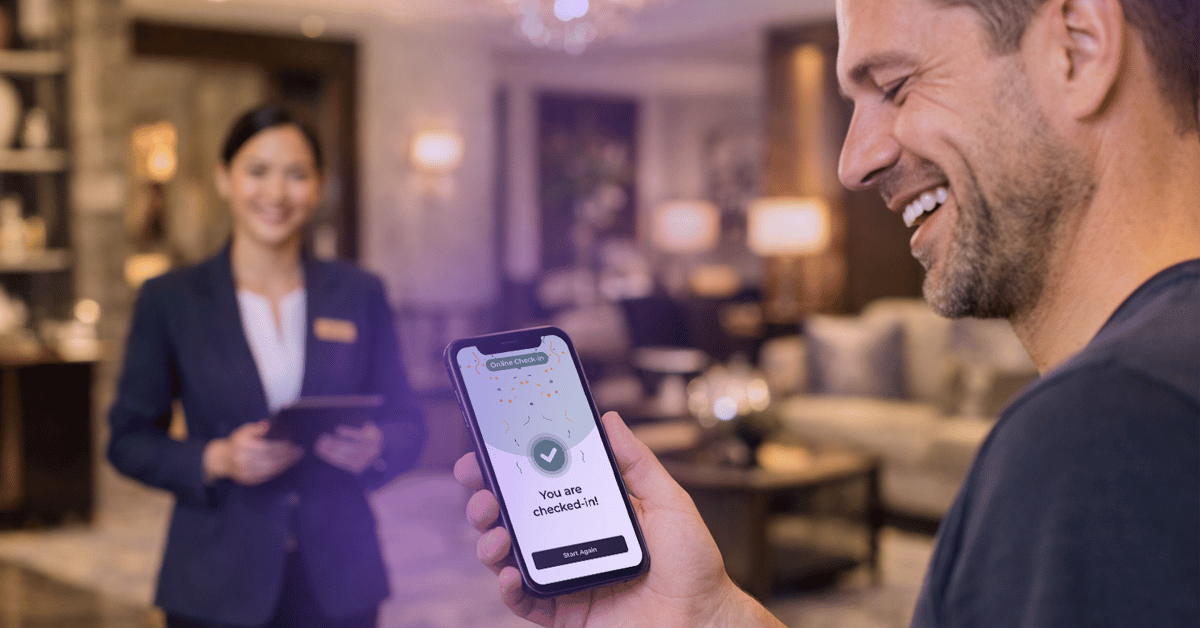
Your CRM automatically sends a mobile-optimised guide featuring parking instructions, digital check-in links, and local staff picks for dining. This helps your guest feel considered and welcome. |
| Arrival Date |
An automated text is triggered welcoming the guest, describing their room, and offering preliminary services and upsells. |
| 2 Hours Post-Arrival |
Your CRM sends a check-up message asking "How is the room? If anything isn't perfect, let us know." This is critical for catching issues before they become negative reviews. |
| Check-Out Day |
An automated "Safe travels" message with a direct-booking discount code is sent for their next stay, supporting your hotel guest retention strategies. |
| 30 Days After Check-Out |
Another recap message is sent, offering the same direct-booking discount code, and a complimentary breakfast for the upcoming seasonal holiday, ensuring your hotel stays top of mind for your guest. |
By streamlining your guest communications through a modern and capable CRM system, you make sure that every guest gets your full dedication, even when your team is small and budget is constrained.
How CRM Personalises the Guest Experience
Another critical aspect of how CRMs improve guest communication in hotels is the ability to leverage data to personalise guest stays and make digital messages feel human. A standard "Dear Valued Guest" template signals that your guest is just a reservation number. This is particularly true for smaller boutique hotels that should feel more rustic and welcoming.
Modern CRM tools allow for conditional logic in messaging. This means the content of the message automatically changes based on who the guest is, rather than just pulling their name from a database.
Here are some examples of subtle message changes that go a long way to make guests feel seen and understood within their context:
- Welcome Back Variations: When your hotel CRM identifies a returning guest tag, the pre-arrival email automatically changes its greeting to: "Welcome back! We've made sure to have [Previous Preference] ready for you again."
- Local Variations: If the guest's address is within 50 miles, the email can skip the "Airport Transfer" information and instead highlight other relevant details, such as your parking policy or dining packages.
- Corporate Variations: For business travellers, your CRM can tailor communication to focus more on Wi-Fi speeds, quiet zones, and express breakfast options; details that are much more important to workers than leisure travelers.
Reducing Staff Fatigue and Response Time
Poor communication doesn’t just damage guest relationships, but is also a primary cause of staff burnout. Studies show that poor hotel staff communication makes employees feel unsupported, undervalued, and emotionally exhausted, leading to reduced professionalism and high turnover (quit) rates (ScienceDirect, 2025).
This hidden cost can be reduced by centralising communications through a modern CRM system, making sure that your staff can focus on the work in front of them in peace. We can illustrate this point with an example:
“A guest message arrives at the front desk. Room 223 asked to have their room WiFi activated before their arrival, and they will pay at the front desk…”
- Reply Without CRM: The front desk receives the message, spends fifteen minutes crafting a response that is concise, but friendly and professional. The message is sent and a post-it note is stuck to the computer for the incoming front desk to handle. The incoming front desk doesn't see it and the task remains unresolved.
- Reply With CRM: The CRM triggers an automated response to the common question. It creates a task for the front desk and closes the ticket when it’s done. The response is logged in the guest profile automatically without human intervention.
By implementing a modern CRM, independent hotels can reduce their average response time from hours to minutes, directly meeting the expectations of the modern traveller. Simultaneously, a CRM can reduce the immense pressure of hotel front desk communication by automating routine chats and requests.
CRM and Guest Communication: Wrap-Up
Improving your hotel's guest communication is a matter of quality, not necessarily quantity. When a CRM centralises your guest information into a single source, it allows you to proactively manage the guest experience and tailor it to suit their specific needs.
Your Tactical Roadmap for Next Week:
- Consolidate: Route your OTA and direct emails into one CRM-driven inbox.
- Automate: Set up one "Pre-Arrival" and one "Post-Arrival" trigger.
- Analyse: Review your "Response Time" metrics. Aim for under 15 minutes for in-stay requests.
Why Noovy?
At Noovy, we believe that hospitality CRM solutions should enable human connection, not replace it.
Our Unified Messaging Hub is designed specifically to centralise your guest details into a unified profile and inbox, tailor your communications to encourage guest loyalty, and empower your staff by handling routine requests.
Our range of modern CRM solutions for the independent hotelier include:
- SMS automation for routine guest information.
- AI-powered digital concierge for guest communication.
- Centralised guest profiles and hotel inbox.
And much more! Ready to improve your hospitality communication? Stay one step ahead with Noovy’s integrated CRM tools and automated guest messaging, designed to put your guests and staff first. Book a free demo with our team today!
Frequently Asked Questions