Hotel Booking Engines: The Ultimate Guide for Independent Hotels
-
Shifting just 10% of your OTA traffic to a direct hotel bookings path can increase your net operating income by thousands of euros every year.
-
Modern engines allow you to unmask the 21% of guest records typically hidden by “masked emails" from OTA platforms (Hospitality Benchmark Report, 2025).
-
Hotel marketing and tech providers report 10 - 30% increase in conversion rates for hotels that implement mobile‑first, optimised booking engines.
If you run an independent hotel, then you know that a full house doesn’t always translate into full profits. While high occupancy is the goal for any hotel, OTA commissions take a significant cut of up to 30% from your revenue (Hotel Tech Report, 2025). It’s no wonder that many hoteliers are left feeling like they work for travel agencies more than they do for their own property.
That’s why a hotel booking engine is your most powerful tool for profit recovery, able to boost direct bookings with up to 60 % higher revenue per reservation from guests being more likely to spend (SiteMinder, 2025). Furthermore, modern booking engines collect real data and unmask OTA hidden guest profiles, empowering you to build loyalty and positive momentum with your customers from the get go.
In this ultimate guide, we’ll explain what a hotel booking engine is (and what it isn’t), outline the must‑have features, guide you to choose the best engine for your hotel and reveal how to unmask valuable customer data to strengthen guest relationships.
Ready to maximise your direct bookings and revenue? Book a free demo and get acquainted with Noovy's revolutionary tech stack today!
Table of Contents
- What is a Hotel Booking Engine? (And Why You Need One)
- Advantages of a Hotel Booking Engine
- Five Essential Features for a Hotel Booking Engine in 2026
- Data Activation: How to Unmask Guest Information
- How to Choose the Best Booking Engine
- How to Calculate your Hotel Booking Engine ROI
- Hotel Booking Engines: Wrap Up
- Frequently Asked Questions
What is a Hotel Booking Engine? (And Why You Need One)
A hotel booking engine is the software on your website and social channels that allows guests to check availability, see live prices and confirm their stay with your hotel instantly.
It connects directly to your Property Management System (PMS), so that rates and room availability update in real time. When a guest books a stay with you, the reservation flows straight into your system without any manual entry, delays, or double bookings.
Nevertheless, many independent hotels still rely on outdated request forms and clunky legacy tools. Instead of showing live prices and confirming bookings instantly, these approaches need guests to submit an enquiry and wait for a manual response from the hotel front desk.
Real Time vs. Request Based Booking Systems
- A Real Time Booking Engine is instantly synced with your inventory. When a guest clicks "Book Now," the room is removed from all other channels immediately.
- A Request Based System sends an email to your front desk, requiring manual confirmation. In 2026, request-based systems are the leading cause of guest drop-off and overbookings.
In 2026, that simply doesn’t work. Not only do you risk overbooking, but today's travellers expect immediate confirmation. If guests can’t secure a room in under a minute, they’ll leave your site and book through an OTA instead. In fact, a March 2025 study shows that direct web bookings are on par with OTA bookings (HEDNA, 2025), making the modern direct booking engine a 2026 essential for your booking mix.
From a financial standpoint, hotels spend up to 40% of their room revenue on marketing and distribution costs, including OTA commissions and channel fees (STR, 2026). This means that every booking you shift from an OTA to your direct channel avoids a commission hit, and is almost a full profit.
In short, a modern booking engine can turn your website from just a brochure into a profitable sales channel that pulls its own weight.
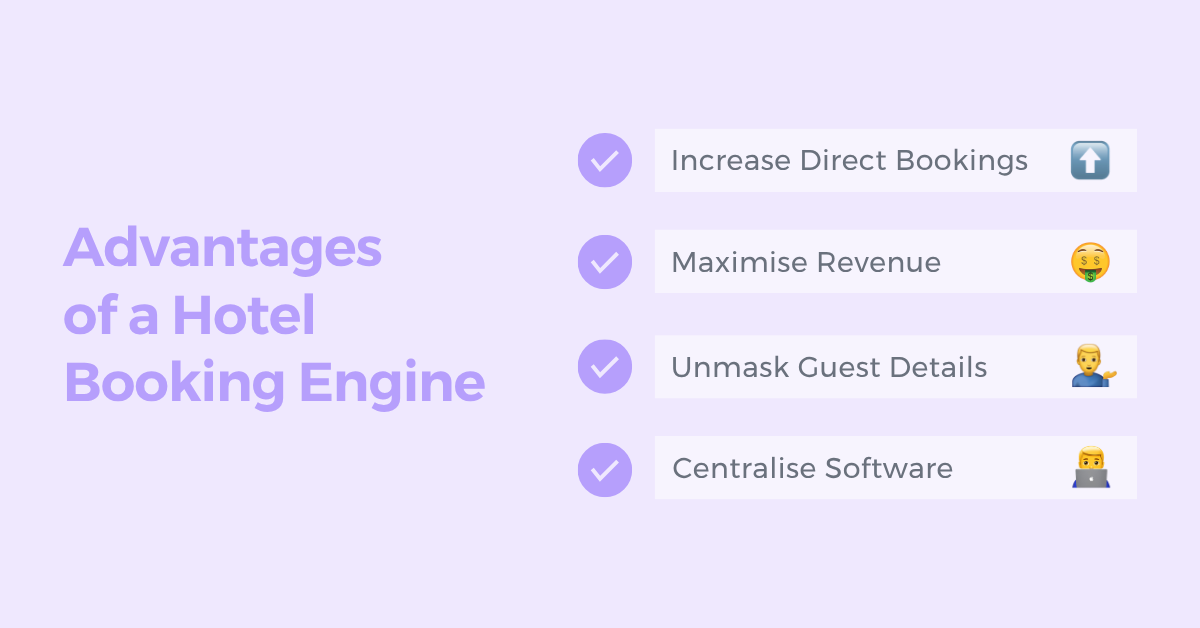
Advantages of a Hotel Booking Engine
More than just processing reservations, hotel booking engines give you control over your revenue, data and guest relationships. Here are some more key advantages of a hotel booking engine for website:
- Increase direct bookings: Hotel booking engines allow you to take ownership of your reservations by giving you the opportunity to encourage guests to book directly through your website. By cutting out the middle man, you build stronger, more direct relationships with your guests and explore opportunities for personalised offers and upselling that third party OTAs would seize commission on.
- Maximise revenue: OTAs charge between 15 % - 30 % commission per booking. Direct reservations through a hotel website booking engine eliminate these commissions, significantly boosting your profit margins by the thousands in additional revenue every year.
- Unmask guest details: OTA bookings typically provide alias emails, preventing you from getting into direct contact with your guests and nurturing positive loyalty. A direct booking engine captures direct contact data so you can personalise communication, tailor offers, and create a deeper guest loyalty.
- Centralise software: A modern hotel booking engine offers integrations with your PMS, CRM, RMS and much more, allowing you to centralise your data and make the most efficient decisions to maximise hotel revenue and reduce manual labour.
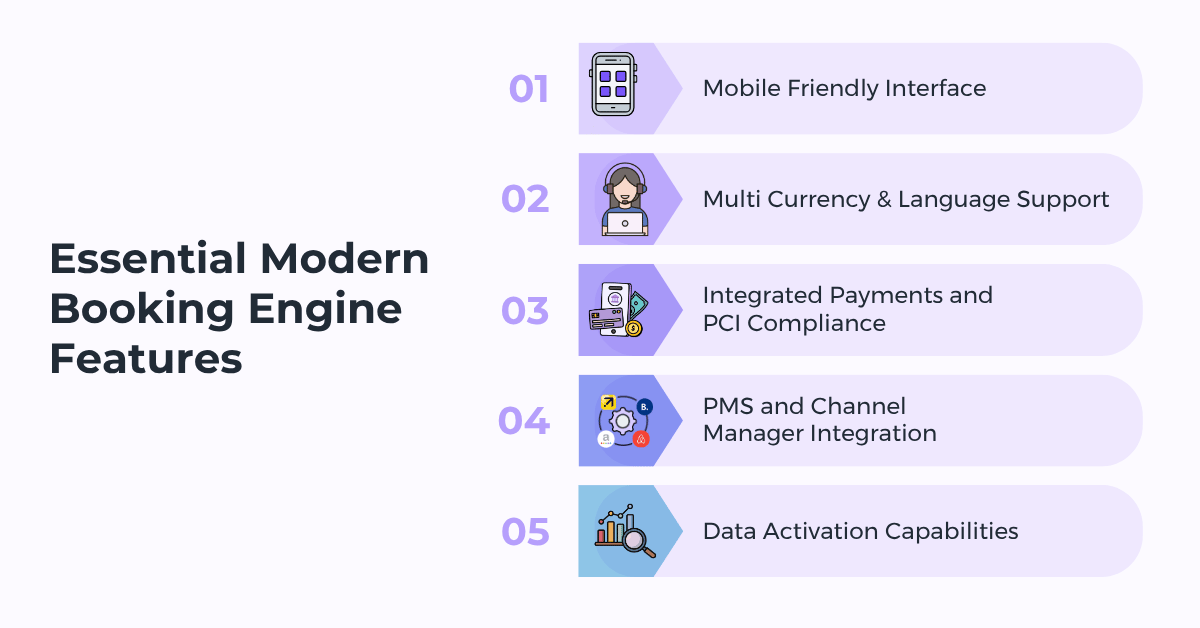
Five Essential Features for a Hotel Booking Engine in 2026
The best hotel booking engine hinges on your specific property requirements, available budget, and scope of operation you are aiming for. A high converting, modern booking engine should do more than just display your rooms and prices, but create a fast, intuitive and thorough booking path for your guests.
Here are five essential features to look for in 2026:
-
Mobile Friendly User Experience
Studies show that over 50 - 60% of independent hotel bookings today are now researched and completed entirely on mobile devices (HospitalityNet, 2025). Having a mobile optimised booking engine is essential to access the full potential of the traveller market. Beyond simple mobile responsiveness, your website should load quickly and be easy to navigate. Avoid lengthy texts, winding paths, and keep the guest experience intuitive and easy. -
Multi Currency & Language Support
Independent hotels often attract international guests, and with budget airlines, global travel has never been more popular. With that in mind, forcing a guest to manually calculate your costs and exchange rates is a nuisance you can’t afford.
A modern hotel website booking engine should automatically detect the visitors location via IP address, and display tailored rates in their local currency and language. This small detail goes a long way for building trust and signaling professionalism to your visitors.
-
Integrated Payments and PCI Compliance
Booking engine efficiency is not just for guests, but also your team. If your guests cannot receive a confirmation until your staff have manually typed credit card details into a physical terminal, then the flow of efficiency is halted.
Integrated payment processing allows for deposits and full payments to be withdrawn automatically at the time of booking. This reduces over 500+ hours of manual labour each year (HospitalityNet, 2025), eliminates the risk of human error, and protects your business and guests money from fraud with PCI compliance.
-
PMS and Channel Manager Integration
In today's hospitality landscape, software integration is non-negotiable for a successful hotel operation. By syncing your booking api with your PMS, channel manager, revenue manager and more, you can update room availability, live rates, and restrictions in real time.
Without proper software integration, you risk double bookings, price discrepancies, human errors, and countless hours of manual work. When your systems speak to each other, you can ensure top shape accuracy across all OTAs and your own direct channels.
-
Data Activation Capabilities
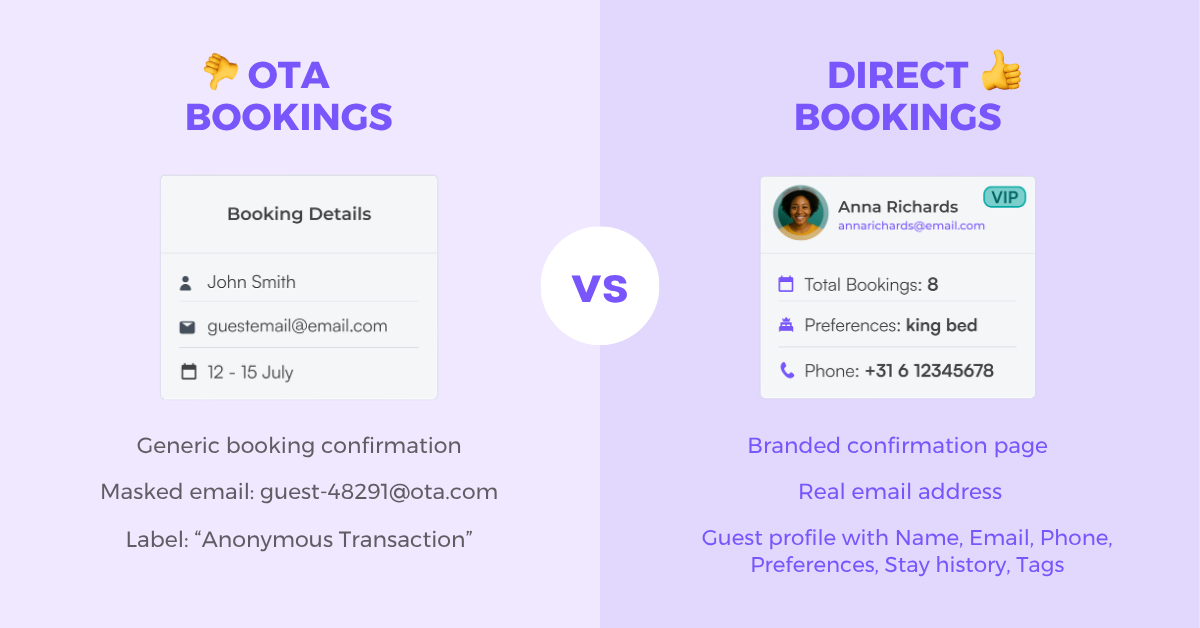
Guest data is a treasure trove for building loyalty and positive relationships. Most OTAs tend to mask guest contacts under alias emails and numbers, thus robbing you of the chance to activate your data, and create a personal relationship with your guests.
A modern booking engine unveils guest information, feeding booking details into your CRM and guest profile database. This lets you send automated confirmation emails, pre‑arrival upsell messages and post‑stay review requests, turning a single booking into long‑term loyalty.
Data Activation: How to Unmask Guest Information
One of the biggest frustrations for independent hoteliers is the problem of masked emails.
When a guest books through an OTA, hotels often receive a temporary or encrypted email address generated by the OTA themselves (e.g. guest456@booking.com). This prevents hoteliers from building direct relationships with their guests through pre-arrival marketing and communication.
A modern direct booking engine solves this by unmasking the guest and giving you access to real first party data. By capturing your guests' real contact information at the source, you can activate that data immediately and create direct pre-arrival communication with them. Some key reasons why this matters is:
- Personalised marketing: Knowing a guest’s real email, preferences and booking history lets you tailor welcome messages, upsell offers and post-stay surveys. Research shows that direct marketing campaigns generate higher open and conversion rates when hotels leverage guest profiles in their communication.
- Data independence: By building your own database of first party data, you reduce your independence on OTAs and third‑party algorithms. This data independence empowers you to increase direct bookings, and foster positive relationships with your guests.
- Cost control: With direct channels, every transaction avoids commission fees and recirculates profit back into your operation. You also decide cancellation policies and payment schedules without OTA restrictions.
- Lifetime value: Guests who book directly often choose premium rooms and stay longer. Capturing their data allows you to retarget them for repeat stays, increasing lifetime value.
What is Data Activation?
- Sending personalised pre-arrival emails.
- Offering room upgrades and add-ons.
- Adjusting prices based on booking trends.
- Encouraging repeat stays with targeted offers.
How to Choose the Best Booking Engine
A suited hotel reservation software can strengthen your profit margins, free up manual labour, and encourage data driven guest loyalty for your hotel for years to come, but choosing the right hotel booking engine software is a decision that requires understanding your needs.
Follow this ten-step framework to ensure you select a partner, not just a provider:
-
Calculate Your OTA Costs
How much do you pay OTAs annually in commissions? On average, direct hotel bookings generate 60 % more revenue per reservation than OTA bookings (SiteMinder, 2025). Knowing your commission bleed can help figure out your budget and justify the investment in a hotel internet booking engine. It can also help set clear return on investment (ROI) targets. -
Identify Your Essential Features
There is no shortage of tech vendors on the market, so make sure to list the most important features your booking engine needs. From mobile responsiveness to multilingual support, tech stack integration to payment options, make sure to prioritise the features that best align with your guest demographics and business goals. For example, if you cater to international travellers, multi‑currency support is critical. -
Test The Booking Process
Put yourself in the shoes of the guest when familiarising yourself with the booking engine. Make sure that the booking flow is intuitive and device friendly, with minimal steps and clear actions. Look for quick load times and accessibility features that create a frictionless user experience. -
Make Sure It Connects With Your System
With a white label hotel booking engine, integration is key to a long term solution. Make sure that the booking engine has an open API or native integrations with your PMS, CRM, revenue management and marketing automation tools. Real‑time synchronising prevents data faults and frees up manual labour. -
Ensure It’s Secure
Ask vendors about PCI DSS certification, SSL encryption, GDPR compliance and secure data storage. Your booking engine provider should offer role‑based access controls and two‑factor authentication. This compliance protects you from fines and reputational damage. -
Look at Costs vs. Savings
Booking engines are usually priced by subscription, transaction fees or a combination of the two. When doing a hotel booking engine comparison, check how each software handles variable costs (e.g., payment gateway fees) and whether they charge commissions. You can even use our hotel booking engine ROI formula to project your potential payback period.
-
Check Training and Support
Implementation of a new booking engine doesn’t have to be stressful. Does your chosen vendor offer 24/7 assistance? Are there self‑service knowledge bases? Assess the onboarding process, training resources and support availability provided to you. The right partner will empower your team to get the most out of the booking engine tool.
-
Book a Demo
Try before you buy! Most tech vendors will be happy to provide a free trial or demo specific to your property. Test real world scenarios like rate changes, room blocks and special offers to see how the booking engine functions. Also, check how quickly the engine reflects changes from your PMS and how easy it is to manage packages and promotions. -
Choose a Trusted Partner
The best partner will have a proven track record in hospitality tech, and a future forward roadmap. Do they invest in AI, machine learning and new distribution channels? What do customer testimonials say? Any case studies that can offer insights into long‑term satisfaction? Remember, in an ideal scenario, you’re entering a multi‑year partnership.
-
Make Sure it Fits Your Hotels Needs
Finally, ensure the solution fits your existing systems and staffing. If your team is small, prioritise ease of use and automation. If you manage multiple properties, look for centralised dashboards. Aligning the tool with your operational realities ensures quick adoption.
How to Calculate your Hotel Booking Engine ROI
Like any investment, hoteliers are likely to ask themselves; how quickly will this pay for itself? The good news is you don’t need financial expertise to figure it out. You can estimate your booking engine ROI using our simple formula.
Booking engine ROI comes down to avoiding commissions. Every booking you shift to your website saves you the 15% - 30% commission you would have paid to an OTA. Instead of thinking about ROI as “new revenue,” think of it as revenue you’re no longer giving away.
What do I need to calculate ROI?
To calculate your annual ROI, you only need four numbers:
- C = Annual cost of your booking engine (Subscription + transaction fees + any setup costs spread over the year)
-
N = Additional direct bookings per year (Bookings shifted from OTA to direct thanks to the new engine)
-
R = Average revenue per booking (ADR × average length of stay)
- k = Your OTA commission rate (For example, 20% = 0.20)
To start, we first calculate the annual commission saved with a direct booking engine. We can do this by multiplying our extra direct bookings, booking value, and commission rate as so:
Annual benefit = N x R x k
Once we know our annual savings, we divide our booking engine cost by that number:
Payback Period (Years) = C ÷ (N × R × k)
And there you have it; an average payback period for your chosen booking engine.
It’s important to note that there is no “universal” average ROI for hotel booking engines, and that every property is different. Your ROI will also depend on factors such as your ADR, length of stay, OTA commission rate, how OTA dependency and much more.
Hotel Booking Engines: Wrap Up
A modern hotel reservation system is a core asset in the world of hospitality, opening boundless possibilities for reclaiming revenue and relationships. In fact, direct bookings generate around 60 % more revenue per reservation than OTA bookings and give you full ownership of guest data (SiteMinder, 2025).
By choosing a room booking system with mobile‑first design, robust integrations and data‑activation capabilities, independent hoteliers can turn their website into their most profitable channel. Combined with tactics such as social media marketing, pre and post stay communication, and stellar guest service, your hotel can be well on it's way to years of success!
Why Noovy?
Noovy’s all‑in‑one platform merges a booking engine with a PMS, channel manager, CRM, AI‑powered messaging and much more. It gives you real‑time inventory sync, dynamic pricing and automated communications all under one roof, so that you make the most of your hotel.
Ready to stop bleeding commissions and start owning your guest journey? Book a demo today!

Frequently Asked Questions
What is a hotel booking engine?
A hotel booking engine software is an application that allows guests to book rooms directly on a hotel's website, bypassing third-party OTAs.
How much does a hotel booking engine cost?
Costs vary, but modern SaaS models typically charge a flat monthly fee rather than a commission per booking, making them more cost-effective for smaller, independent and growth minded hotels.
Do I still need OTAs if I have a booking engine?
Yes, OTAs are an excellent tool for discovery, especially for smaller independent hotels, but your goal should be to use your booking engine to convert those first-time discoverers into direct, loyal guests for their second stay.
What is an "Open API" in hospitality tech?
An Open API allows different software systems (like your PMS and Booking Engine) to share data instantly and accurately without manual intervention. A hotel booking engine api can seamlessly connect with your tech stack and process multiple levels of data at once.
What is the best booking engine for independent hotels?
While there is not one shoe that fits all, the best hotel booking engines are ones that are mobile-optimised, support multiple currencies, and integrate natively with your PMS to ensure "unmasked" guest data is captured and activated.