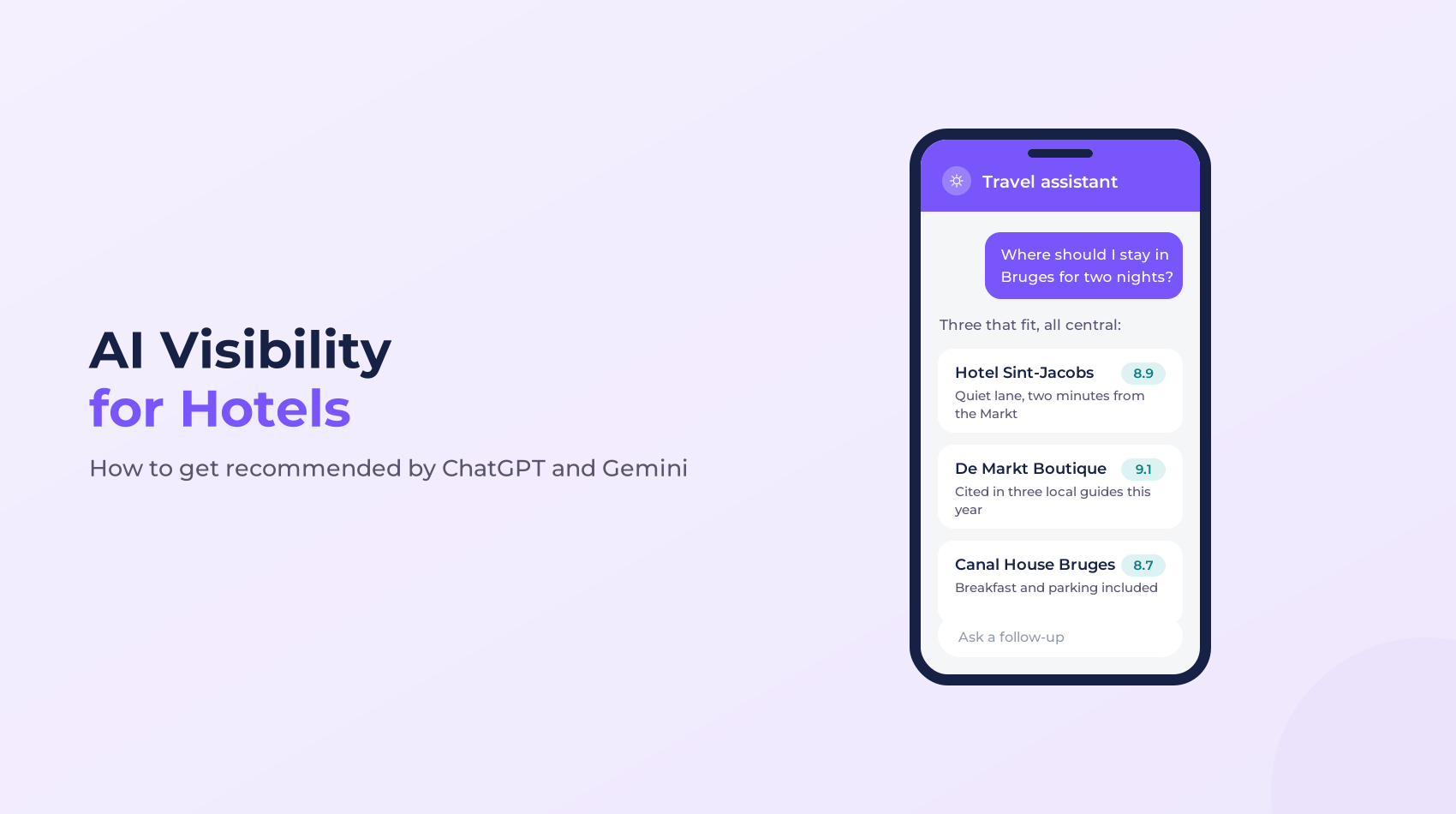
AI visibility for hotels is quickly becoming an indispensable asset in reaching potential travellers. The process revolves around a simple question; when a guest asks an AI assistant where to stay, does your hotel get mentioned? This visibility is only going to matter more as European travelers increasingly use AI to research their trips. More so, the majority of AI users researching travel claim that their decisions were greatly influenced by AI answers.
Asking AI about your own town, there’s a fair chance you might not see your hotel come up as often as you wish it did. Luckily, improving hotel AI visibility is not that impossible or expensive. Most AI assistants mention independent travel guides far more frequently than they do direct hotel websites, which means the work that gets your hotel recommended mostly happens away from your own website. You just need a simple hotel booking engine to catch the direct reservations.
This tactical guide will teach you how AI assistants choose hotels, which steps to take first, how to check your hotels AI visibility, and what ranking services are legitimate and worth paying for.
Ready to drive AI visibility into direct hotel bookings? Noovy’s state of the art hotel management suite contains all the tools you need as an independent hotel to maximise your earning potential. Book a free demo today with a Noovy expert to get acquainted!
Table of Contents
What Is AI Visibility for Hotels?
Can Guests Book Your Hotel Directly Through ChatGPT?
How Do AI Assistants Choose Which Hotels to Recommend?
How Much Does Your Hotel Website Matter for AI Recommendations?
How Do You Measure Your Hotel's AI Visibility?
How to Get Your Hotel Recommended by AI
Is It Worth Paying For AI Visibility Services?
AI Visibility For Hotels: Wrap-Up
Frequently Asked Questions
What Is AI Visibility for Hotels?
AI visibility for hotels is about how likely your hotel is to be mentioned by AI assistants online when guests search for where to stay during their trips. Some of the most popular AI platforms include ChatGPT, Gemini, Perplexity, Microsoft Copilot or Google's AI Overviews. A hotel with strong AI visibility is often cited in answers. A hotel with weak visibility rarely appears at all.
The difference of AI visibility from normal search engine visibility is in the format of information. On Google, a guest sees a full page of links, and scrolls to find what’s interesting. With an AI assistant, a guest asks a question, and gets a precise, plain language answer.
If a guest asks an AI assistant to find “quiet hotels near central Paris that include breakfast”, the answer will return with three or four key hotels. This reduces the scope of the travellers decision. If your hotel is not amongst those mentioned, the chances of them discovering you are far lower than with a search engine. This alone makes AI a very important hospitality trend.
The process of improving AI visibility is called either generative engine optimisation (GEO) or answer engine optimisation (AEO). Both describe the same work in terms of AI optimisation for hotels, which is to make it easier for AI assistants to find, trust and recommend your hotel.
Can Guests Book Your Hotel Directly Through ChatGPT?
Usually not. While travel agencies like Booking.com, Expedia and Kayak have begun adding booking tools inside AI assistants, guests still mostly use AI to find and compare hotels, then book on the hotel's own website or directly through an OTA. When bookings do happen inside ChatGPT, it typically runs through an OTA's own app built into the assistant. As a result, your hotel mostly still receives the booking as an OTA booking.
Research firm Phocuswright describes AI platforms as being at the very beginning of the process, mostly serving as an advanced search engine for travellers looking for specific hospitality details. For independent hotels, this helps determine where to spend effort.
An AI can shortlist you in an answer, but it will still send the reader onwards to book. This makes the place that a guest lands (your booking engine, OTA listings, rates on metasearch) matter the most. A hotel that gets recommended by ChatGPT but has an out-of-date OTA profile or a clumsy booking engine loses the guest at the last step to inconvenience.
Guests do compare prices after an AI suggests hotels, which is why showing up on price comparison sites still matters. Google Hotels now blends AI features into the same results where guests compare rates, so this is one place where AI search for hotels and ordinary price comparison meet. Our guide to Google Hotel Ads covers how that works, and our guide to balancing OTAs and direct bookings covers the channels themselves.
How Do AI Assistants Choose Which Hotels to Recommend?
AI assistants recommend hotels by crawling the web and reading various sources to find a consistent narrative about a hotel. When multiple sources are outdated or disagree with each other - such as different addresses, amenities, and prices - the AI assistant is more likely to leave it out entirely.
Different AI agents read different parts of the web. For example, ChatGPT’s search algorithm relies heavily on Microsoft’s Bing, while Google’s AI overviews draw directly from Google. This is why Bing matters far more than most hoteliers might expect, and why claiming your free Bing Places listing is one of the most useful steps you can take.
A Phocuswright study on AI and the travel industry revealed the top three AI answers that made travellers act on the suggestions they were being given (Phocuswright, 2026):
- Price Comparisons: When AI assistants are prompted to provide a price comparison between hotels, or to provide hotel options within a price range. Price ranges showed a success rate of up to 44% in influencing traveller decisions.
- Summarised Reviews: When AI assistants are prompted to create short paragraph or bullet point summaries that condense important information about a hotel. This format has seen a 33% success rate in influencing traveller decision making.
- Recognised Brands: When AI assistants pulled recognised brand names when answering traveller questions, accounting for 32% success in influencing decisions.
The third format is where independent hotels are at a disadvantage, simply because chains like the Holiday Inn invest millions of euros into their global marketing and brand image. Whilst a 20 room hotel might not be able to compete on name recognition, it can still do well on the other two: land on price comparisons and have reviews that an AI can summarise clearly.
Reviews matter in a specific way. Reviews that mention concrete details — the breakfast, how quiet the rooms are, the five-minute walk to the old town — give an AI the exact words it needs to match a guest who asks for those things. A long list of reviews that just say "great stay" tells it very little. Our guide to hotel reputation management covers how to get more reviews and respond to them well.
How Much Does Your Hotel Website Matter for AI Recommendations?
In a study by Stiplo on Barcelona hotels, an analysis of 27,360 AI travel answers showed that up to 76% of results cited at least one editorial "best hotels" guide crawled online, while the hotel's own website was cited only about 7% of the time (Stiplo, 2026).
These findings highlight useful takeaways about AI citation behaviour, and help determine what matters most for AI recommendation. AI assistants for hotel visibility get most of their information from:
- Editorials and Travel Guides: Best hotels lists, editorials, and listicles by blogs and magazines online are cited by AI to decide which hotels are worth naming. As an independent hotel, getting listed and mentioned through sponsored content or networking is a useful step to take.
- Review Platforms: AI uses review scores and uploads to gauge the sentiment and opinions of what guests experience at your hotel. Aim to earn detailed reviews on public OTAs and platforms, and make sure you answer them in a timely manner.
- OTA Listings: Used by AI assistants to check facts, prices, amenities and other core details about your hotel. Your job is to provide full and updated details about your hotel across every OTA channel to make sure there is a single unified truth for AI.
- Business Profiles: Google Hotels and Bing Places profiles are used as trustworthy sources by ChatGPT, Gemini, Microsoft Copilot and other AI assistants to confirm key hotel details such as location, hours and amenities. It’s important to claim your free account and complete both fully.
- Hotel Website: Used by AI assistants to confirm details and sometimes even take the booking. This is important, as it increases your chances of bypassing OTA commissions. Make sure to keep your hotel website accurate and easy to book on.
Before naming a hotel, AI assistants crawl the web for sources that agree with each other about your hotel. Therefore it's important to have a varied online portfolio to help increase the chances of citation. Your hotel website is your own description of your hotel. Travel guides, review platforms, and OTA listings are independent sources that strengthen this description. Together, they form a content ecosystem that carries far more weight.
How Do You Measure Your Hotel’s AI Visibility?
The best way to measure your hotel’s AI visibility is by asking it directly. Work with the most popular platforms like ChatGPT, Gemini, Perplexity, Copilot and Google for a varied understanding. Start by directly naming your hotel and asking questions about it a guest might ask. Record how the answers appear and use this as your baseline of improvement.
It’s important to treat each AI assistant as a separate audit, because they all draw from different sources. Even Google’s Gemini and its AI Overviews can give different answers.
Does AI Know Your Hotel?
Start with your hotels own name, and ask each assistant a series of simple questions:
- What can you tell me about the [hotel] in [city]?
- What room types and amenities does [hotel] have?
- How much does a [room type] cost in [hotel]?
Be cautious, as AI assistants sometimes invent false answers when they don’t have one. For this reason, make sure to check every detail, such as star rating, location, room types, amenities, and price.
Does AI Recommend Your Hotel?
For the next step, ask questions without your hotel name as if you are a curious traveller. You can ask a series of specific questions which you believe your hotel should show up for, such as:
- I’m looking for a hotel in [city] near [train station] with a complimentary breakfast.
- Which family hotels in [city] have free parking and cost under €150?
When you get the answers, take a detailed note of what they say. Did your hotel appear? Where in the list did you appear? If not, which hotels appeared instead? Which sources did AI quote?
Caution: If an AI assistant does not show its sources, ask it. This matters, because it shows which sources AI trusts, and whether you need to find yourself in those sources.
Where Does the AI Send Your Guests?
When your hotel does show up in AI answers, check where the citation hyperlink goes (your website, OTA listing, blog article, or Google page). Click it and read it as a guest would. If it leads to an old page or an out of date listing, make sure to update the page as this is the first thing your potential guests are seeing.
What Do the Results Tell You?
- Little to no results. If you are not seeing your hotel, then the basic informational steps are probably missing. Start with claiming your Google and Bing business profiles, making sure all public information is recorded in your website and OTA channels, and that there are no discrepancies in the details.
- Some results, but no recommendations. If you get some hits, but no key recommendations, AI knows you but might not trust the sources it crawls fully. Look at the sources quoted for the hotels it named and recommended instead. Those are the travel guides, listings and social channel content worth getting into.
- AI recommends you but gets the details wrong. If you’re getting hits, but they are inaccurate, check the sources that AI is quoting. If any of them are out of date or inconsistent, fixing them fixes the answer.
Once you have a baseline established, make sure to track these questions monthly and look for any emerging trends as time passes. This is especially important if anything changes your facts online (such as a price change, new amenities or hotel renovation).
There are paid AI visibility tools on the market designed to automate audits, but these are more useful to mid and large sized hotels with several properties. For a single boutique hotel, the monthly audit is a good place to start.
How to Get Your Hotel Recommended by AI
To get your hotel recommended by AI assistants, there’s a range of quick and free steps to take. Claim your Bing Places and Google Business Profile listings, keep your hotel's details identical on every platform, complete your OTA profiles, get mentioned in local travel guides, and earn reviews that describe your hotel in detail.
The checklist below is ordered by the impact of each step in improving your AI hotel visibility:
- Claim Business Profiles: Google Hotels and Bing Places profiles are free and only take about five minutes to complete. In return, your hotel is more visible to generative engines like ChatGPT, which draw search results from these business profiles. Fill in every field, add recent photos, and keep opening hours and contact details accurate.
- Keep Details Identical: All public information of your hotel's name, address, phone number, room types, amenities and policies should read exactly the same on your website, business profiles, and OTA listings. Small differences, even spelling mistakes can make an AI less sure about you.
- Complete Full OTA Profiles: AI assistants trust OTA listings as a reliable source of facts, even if you would rather your guests booked directly. Make sure your OTA profiles are up to date and that all fields are filled for maximum visibility.
- Get Featured In Local Guides: Tourism board listings, local "best hotels" articles, regional travel writers and influencer social accounts all help broaden the visibility of your hotel and give AI more things to cite. This one takes a little bit of time and resources, but helps your hotel improve its visibility in the new digital age.
- Ask Guests For Detailed Reviews: Rather than generic answers and basic star ratings, encourage guests by asking them to mention what they enjoyed. Detailed and specific reviews help AI visibility far more than star ratings alone.
- Make Sure AI crawlers Can Read Your Website: Some websites automatically block the tools that AI companies use to read pages. OpenAI states that sites blocking its search crawler are not shown in ChatGPT search answers at all. Asking your web person to check for these blockers can help improve your hotels online visibility.
- Use Schema Markup To Improve Your Website: Add complete hotel details to your website's code helps describe your hotel to machines in a standard format. Ask your web person to include amenities, star rating and exact location, which most hotel websites leave out by accident.
- Create A Website FAQ Section: Answering the questions that guests actually ask with clear, plain answers can help AI find the information it needs. Some examples are; Is there parking? Is it quiet? Can I walk to the centre? What is it near?
By improving your hotels information across websites, OTA listings and business profiles, you’ll likely see an increase in AI visibility for your hotel. Results can take anywhere from several hours to several weeks to show, and entirely hinges on the scope and nature of the changes.
Is It Worth Paying for AI Visibility Services?
Many companies on the market sell AI ranking, AI optimisation, or AI visibility services to hotels. While some offer real structural help, many charge money for free steps you can do yourself. It’s important to know two key facts before signing into a service:
- There is no special AI code for visibility. Google directly states that you do not need to add any special structured data for its AI features to discover you. If someone offers an "AI schema" as a separate product, they are selling the same ordinary schema markup described in this article, which is a quick and easy fix.
- Nobody can guarantee you AI placements. AI assistants do not follow a fixed ranking algorithm the way search results do. Answers vary from one question to the next and from one person to the other. A company promising to get you ranked first in ChatGPT is making a false promise.
What is genuinely worth paying for are the parts of AI visibility optimisation you cannot or are unwilling to do yourself. If your hotel does not have a dedicated IT or content specialist, paying someone to add schema markup and check your crawler settings is a smart and reasonable investment. If you run several hotels, an automated tracker can save a lot of time and effort.
A good test is to check any service offering AI optimisation or AI marketing strategies for hotels against the checklist of free steps already determined in this article.
AI Visibility for Hotels: Wrap-Up
AI visibility for hotels mainly comes down to consistency. AI assistants recommend the hotels that travel guides, review platforms, and OTA listings all describe in the same way. As a result, most of the work happens away from your own website, and most of it costs nothing at all.
The main points to remember are:
- Unlike search engine results which allow the guest to check a broad range of results, AI assistants mostly decide which hotels make a guest’s shortlist for them.
- Travel guides, review platforms, business accounts and OTA listings carry far more weight with AI assistants than your own hotel website does.
- Independent hotels compete best on price visibility and detailed reviews. These tend to drive traveller decisions more than brand recognition does at times.
- There is no special AI code for visibility, and no company can guarantee your hotel placement in AI answers. Be wary of scams and false promises.
To get the best out of your AI hotel visibility strategy, run a baseline audit first so you know where you stand. From this point, you can work through our handy checklist to make sure you position your hotel in the right way. From then on, conduct monthly audits to see what changes.
Why Noovy?
Noovy’s state of the art hotel management system is designed as a supportive backbone to make the most of online visibility. From automated guest messaging and segmented campaigns to data aggregation and modern booking engines, explore features like:
- Modern Booking Engine: Noovy’s booking engine is frictionless, easy to use and customizable to your hotel website. This puts you in the best position to capture direct bookings and divert your earnings away from OTA commissions of up to 30%.
- Centralised Data: Noovy’s property, revenue, guest management systems and hotel channel manager work in tandem to create a unified and updated information base across all departments. This means that the same rates, availability and room information are updated across every channel automatically.
- Automated Guest Messaging: What happens when you’ve collected guest contact details? Noovy’s modern marketing tools allow for automated upselling and guest communications, even directly within the booking flow to maximise revenue.
Ready to improve your hotel's visibility online? Book a free demo of Noovy’s tech stack and see how a connected system keeps every listing accurate.