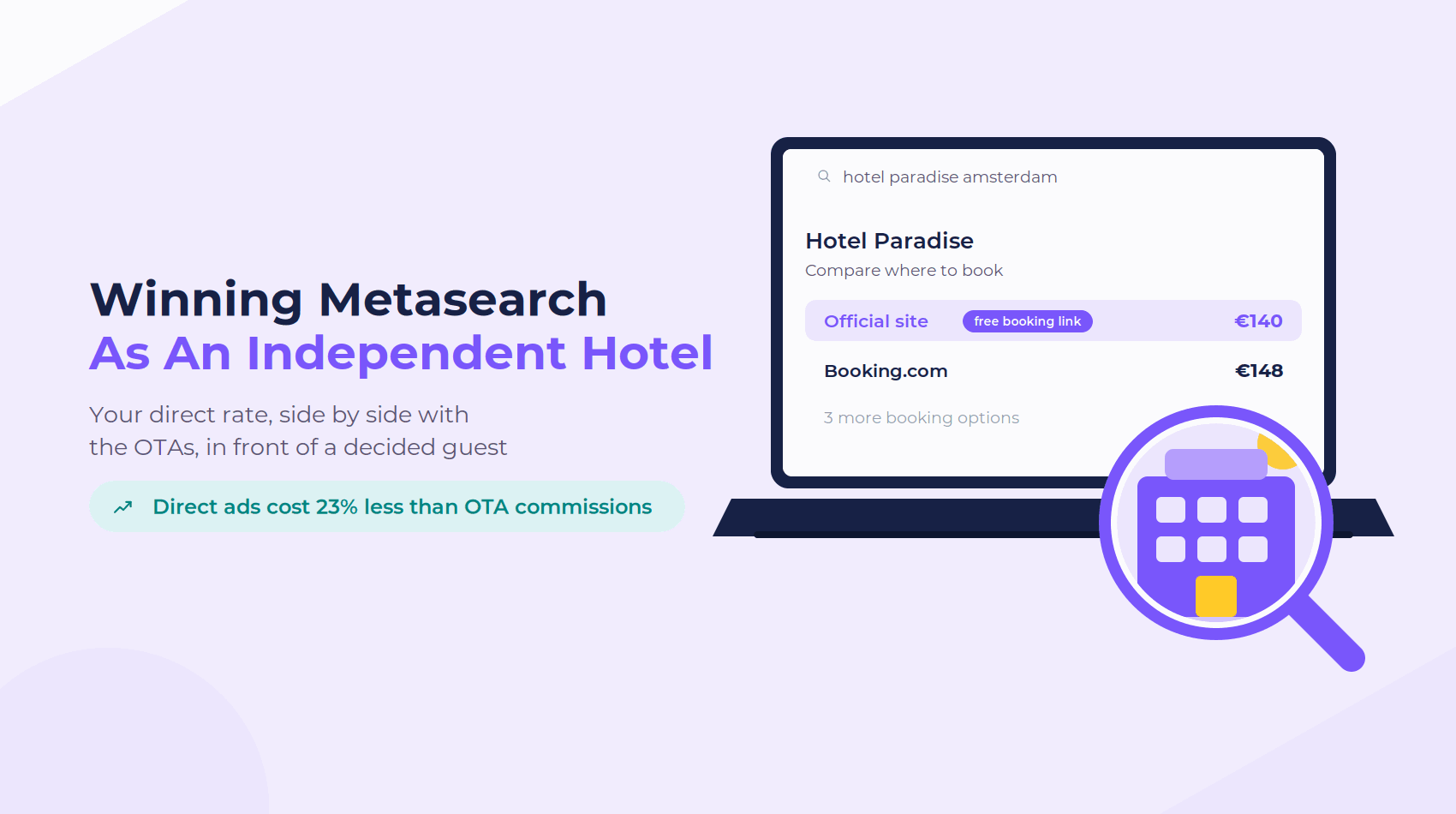
By the time a guest reaches Google Hotel Ads, they have chosen the hotel they will book. What they are now deciding is where to book a room from. Booking.com, Expedia, or the personal hotel booking engine? This is a completely different contest from being discovered online, and it is one that independent hotels are perfectly positioned to win.
Metasearch is one of the most important paid distribution channels for independent hotels. It enables hotels to advertise their own room rates directly alongside OTA rates, capturing high-intent travelers at a much lower acquisition cost. For independent hotels in Europe, metasearch has become considerably easier to win than it was a few years ago.
This tactical guide will cover why metasearch matters for independent hotels, how bidding works, the math that helps to determine whether it’s worth spending money on direct ads or not, and the free listings you probably already qualify for.
Ready to expand the digital reach of your hotel? Book a free demo with one of our experts, and get acquainted with Noovy’s state of the art hotelier software.
Table of Contents
What Is Metasearch?
Metasearch vs. OTAs vs. GDS
How Google Hotel Ads Works
The Break-Even Maths
Beyond Google
The European Advantage
Getting Started
Wrap-Up: Google Hotel Ads
Frequently Asked Questions
What Is Metasearch?
A metasearch engine is a tool that collects and organises online results from multiple channels into a single hub. In tourism, think of it as a rate comparison tool. The same hotel room listing from multiple sources is placed side by side for easy comparison, and interested bookers are redirected to their selected booking source.
This is particularly helpful for independent hotels as they get the opportunity to present their prices alongside OTAs, and interested guests can easily pick the cheapest option.
However, unlike an OTA, a metasearch engine does not process reservations itself. This distinction matters in a commercial sense. While an OTA charges a commission on the stay, metasearch charges for the click, and hands the guest over to whichever booking source they select. That way, hotels can own guest bookings and their details at no commission at all. For hotels looking to reduce OTA dependency, that is the appeal.
The main metasearch engines are Google Hotel Ads, Trivago, Tripadvisor and KAYAK, with Google dominating at an overwhelming 91% of the search engine market share (StatCounter, 2026). For most hotels, it’s the main one worth running.
Metasearch, OTAs and GDS: The Distribution Channel Map
A hotel's distribution channels form a portfolio of pricing and booking sources. The useful question to ask here is what portion of a hotel's digital presence sits in each distribution channel, and how to optimise this distribution for the best results.
The four main distribution channels for independent hotels are metasearch, OTAs, the GDS, and a direct booking engine.
The greatest risk to independent hotels is concentrating too much presence in a single channel. Getting a large majority of bookings from one channel type can reduce a hotel's leverage, whereas a healthy and diverse channel distribution mix keeps a hotel performing in top shape.
How Google Hotel Ads Works
To connect Google Hotel Ads to your hotels booking engine, you need an authorised connectivity partner (typically your booking engine or channel manager) that integrates directly with Google’s feed.
This is where most independent hoteliers find it difficult to make a decision, as there are endless tech vendors on the market that offer software and connectivity packages. Luckily, world class tech vendors like Noovy provide attractive hotel management packages with affordable pricing and enticing additions, such as full Google connectivity and integrated ad distribution.
Google’s own instructions highlight three key steps for connectivity: establish the rate feed, appear in free booking links, and then expand into paid ads if the market justifies it (Google, 2026). Most hotel marketing agencies tend to skip the middle step.
If the answer to all three is no, that is your first task. As the name suggests, free booking links cost nothing, and are only a benefit to hotel visibility.
Google's Free Booking Links: The Slot You Already Qualify For
What most independent hoteliers don’t know is that there are free options for Google placements. Google free booking links display a hotel's direct rate in the same booking panel as the paid ads, at no cost per click and no cost per booking. Essentially, any hotel with a working rate feed can appear in them.
The criteria for free booking links is identical to that of paid ads:
- Online Profile: Your hotel must have a verified Google Business Profile and a matching hotel listing so it can appear in Google’s online booking module.
- Property Registration: Your hotel must be registered as an official hotel property (e.g. inn, b&b,). This includes a front desk, on-site management and the capacity to accept overnight guests. Short term vacation rentals are generally not qualified.
- Connectivity Partner: Your hotel inventory, details, and rates must be connected with Google through an integrated connectivity partner. This is usually facilitated by the chosen hotel tech vendor.
- Booking Engine: Your hotel must have a working, user-friendly landing page and booking engine that allows guests to book stays and checkout through the website.
- Price Compliance: Room rates, additional taxes and any other fees must match the final price that the guest is paying on your hotel's direct booking engine.
The main difference between free booking links and paid aids is the position they take up in Google's listings. Paid ads get more prominent positions with a higher conversion rate, while free links sit much lower in the panel.
In any case, a free but lower representation is infinitely better than no Google representation. To make things better, the clicks are completely free, and thus, it’s highly recommended for hotels to make use of this avenue first before considering spending any money on bidding.
What is Bidding? The Payment Models Explained
Once a hotel decides to invest in paid placements, Google offers several payment methods. For a small to medium sized hotel, the choice of payment method matters a lot, and can be the difference between a smart investment and a burdensome cost:
- Cost Per Click (CPC): When a hotel sets a maximum bid and pays for online traffic whether or not it leads to bookings. This method is predictable, controllable, and very cost transparent. It’s highly recommended for hotels running their first campaign.
- Enhanced CPC: Google adjusts bids around the hotels baseline, raising them when booking looks to be likely. This is more useful for hotels who have built a history of conversion data from ads, and can forecast demand more comfortably.
- Target ROAS: When a hotel specifies the return on investment (ROI) they want, and Google bids to achieve it. This is most effective at high volume, but largely irrelevant for hotels generating a handful of metasearch bookings a month.
- Commission Based: Discontinued since 2025, Google used to allow a commission model where hotels paid a percentage of the booking value rather than per click, thus shifting the risk to Google, not the hotel. This payment method is no longer available.
For hotels starting from scratch, it’s recommended to take the CPC route, with a hard daily cap on spending. While the hotel overpays slightly in this scenario, it gains an extra layer of control to find out whether a click is worth it or not.
Defending Your Brand Name
Brand defence is a separate logic from metasearch bidding. This is when a hotel conducts paid search on its own name. This is a tactical practice that OTAs carry out so that guests searching for your hotel end up booking through a commissionable channel before reaching your site.
The counter narrative to this is that some of that paid traffic would have found your hotel for free anyways, so brand defence is partly buying clicks you already had. Whether it is worth it or not entirely depends on how your hotel is represented on Google. There is a simple test for this:
- Access Google in incognito mode. Searching in incognito mode helps reduce search personalisation by preventing browser history and cookies from skewing results.
- Search your hotel's name. If OTA search results appear above your website consistently, then it might be worth investing in brand defense. If your hotel site is already appearing first, then your money can be used somewhere more helpful.
Breaking Even: When does Metasearch Pay?
Whether metasearch pays or not depends almost entirely on the hotels booking engine conversion rate, not the bid itself. The same click at the same price can produce a profitable opportunity for one hotel, while being a complete financial loss for another.
There is a simple mathematic process to help gauge the potential for profit before investing:
Now that we have our formulas, let’s explore an imaginary case with two different hotels that both feature the same CPC, ADR and average stay:
- Cost Per Click (CPC): €1.10
- Average Daily Rate (ADR): €140
- Duration: Two Night Stay
Despite identical conditions for both properties, one can observe the impact of the booking engine conversion rate on the end results:
| |
Hotel A |
Hotel B |
| Booking Engine Conversion Rate (%) |
3.5% |
1.2% |
| Effective CPA |
€31.43 |
€91.67 |
| Cost as % of Revenue |
11.2% |
32.7% |
| ROAS |
8.9 |
3.1 |
Based on the findings, Hotel A acquires bookings for far cheaper than any OTA commission, whereas Hotel B pays more per booking than even the worst OTA commissions on the market. The results differ even though both hotels have the same rate, click price, and channel.
As a rule of thumb, independent hotels with a booking engine conversion rate below 2.5% and cheap booking values are unlikely to beat OTA commissions through CPC bidding. In this circumstance, it’s recommended for the hotel to fix their conversion rates first.
Beyond Google: Trivago, Tripadvisor and KAYAK
While Google comes first as the majority shareholder of the metasearch spend, there are several other avenues that might be worth considering for independent hotels:
- Trivago: Featuring 5+ million hotels across 190 countries, Trivago is stronger in German-language markets than its global share suggests. For hotels located in hubs like Berlin, Vienna or Zurich, Trivago is a plausible second platform to Google.
- Tripadvisor: Whilst holding a smaller market share, Tripadvisor brings surprisingly high intent traffic value for hoteliers. Guests arriving from a review page have clearly spent time evaluating properly, and are less swayed by price differences.
- KAYAK: Playing a much more secondary role in metasearch for independent hotels, Kayak still carries a useful volume in specific guest opportunities, particularly inbound and long-haul international visitors.
Each of the aforementioned platforms trail significantly behind Google in terms of market share, but all carry some worth as a secondary supportive distribution worth considering.
The European Advantage: Pricing Below the OTA
The advantage for European independent hotels is that new laws allows hotels in the European Economic Area (EEA) to display lower direct prices next to OTA prices on metasearch engines without breaking any rate parity rules.
The advantage for independent hoteliers is massive, as cheaper prices can now be listed directly next to OTA prices that contain commission. This turns the metasearch environment into a place where independent hoteliers can now compete on price.
Despite these positive changes, OTAs continue to play an important role in hotel performance and visibility, as two truths can coexist:
- What Changed?: Parity clauses are no longer legally enforceable against EEA hotels. Hotels may legally price below OTAs on their own website.
- What Did Not?: OTAs still reward competitive pricing in their own rankings. OTA visibility still remains a commercially valuable avenue.
It’s important to note that this only applies to the European context, and US based hotels are not protected by specific legislation preventing rate parity clauses in contracts.
How to Get Started With Google Hotel Ads
When setting up metasearch presence, following the process correctly matters more than the allocated budget. The most disappointing metasearch results hotels experience comes from poor instructions. Here’s our guide to set you on the right track:
- Confirm your booking engine or channel manager is a Google connectivity partner.
- Claim your free booking links slot. This step requires no budget, and should be handled before any paid activity.
- Measure your booking engine conversion rate against the break-even calculation.
- If your conversion falls short, put effort into fixing this first. There is no point bidding when the booking path is losing guests.
- Start on Google only, with a controlled monthly budget and a fixed evaluation window (quarterly) to be able to create a solid data driven understanding of ad performance.
- Measure incrementally. Judge the channel on total direct bookings through your own booking engine, not the inflated last-click attribution.
Google Hotel Ads and Metasearch: Wrap-Up
The value of metasearch for independent hotels cannot be understated, as it’s the only channel that allows independent hotels to place their rates right beside OTA rates on equal terms, in front of guests that have already chosen your hotel.
For European and EEA hotels, that comparison is now winnable due to restrictions on rate parity clauses. However, winning the metasearch requires a booking path that converts. The ideal scenario here is to drive more traffic towards a high conversion booking engine.
That’s where Noovy comes in as your one stop solution to hotel management.
Why Noovy?
Appearing on Google Hotel Ads depends on connectivity you probably do not control directly. That is the part Noovy handles.
- A booking engine built for metasearch connectivity. Your rates reach Google through a maintained connection, so you can appear in free booking links and paid ads without arranging it yourself.
- Live rates from one pooled inventory. The rate shown on the panel is the rate honoured at checkout. Rate feed mismatches are a common and quiet cause of suppressed listings, and they happen when availability lives in more than one place.
- A booking path designed to convert. The break-even calculation in this article turns on one number, and that number is determined by what happens after the click. Noovy's booking engine is built around it.
- Rate flexibility across channels. For hotels reviewing their position now that parity no longer binds, managing direct and OTA rates from one place makes the trade-off visible rather than theoretical.
Ready to elevate your hotel business? Book a free demo and see how Noovy connects your direct rates to Google and converts the clicks you pay for.