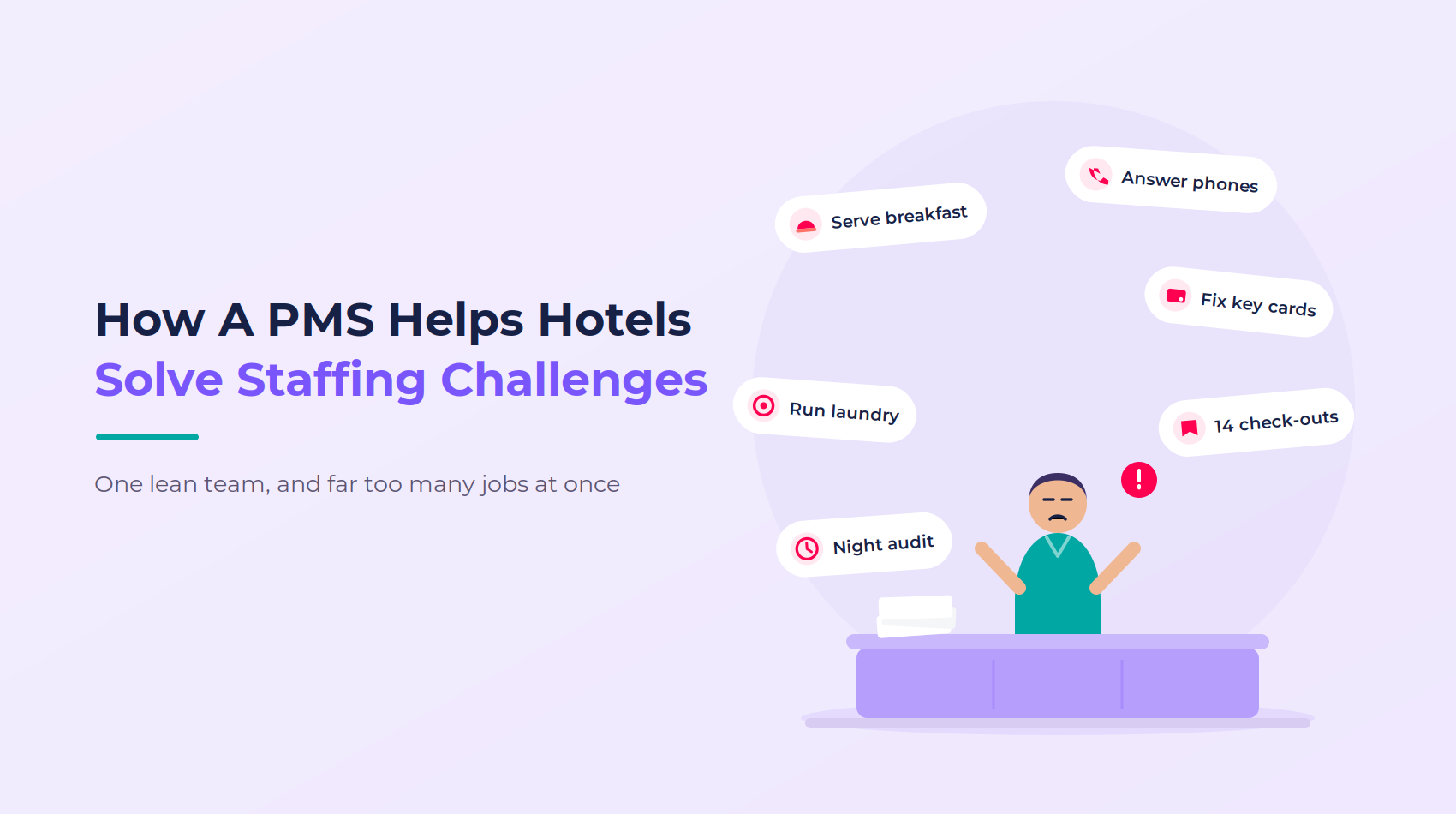
It’s 7:30 in the morning. You’re the general manager at your hotel, but today you’re also the breakfast server because your morning shift didn't show up. Between pouring coffee and handling faulty key cards, you’re mentally calculating how many check-outs you need to supervise while the laundry pile grows.
This is the reality of the hospitality labour crisis in 2026. Independent hoteliers face a two pronged struggle between finding staff, and maintaining the exhaustion of those who remain. Luckily, property management system automation provides a tactical solution that can free countless hours of manual labour and slash your invisible financial drain.
Wondering how a modern PMS can solve your staffing issues? Our tactical deep dive will help you identify common staffing pitfalls, explore PMS based solutions, and make tactical changes for happier staff, guests, and financial prospects.
Book a free personalised demo of our tech stack today, and let one of our experts guide you through its full scope.
Table of Contents
What Are Common Hotel Staff Issues?
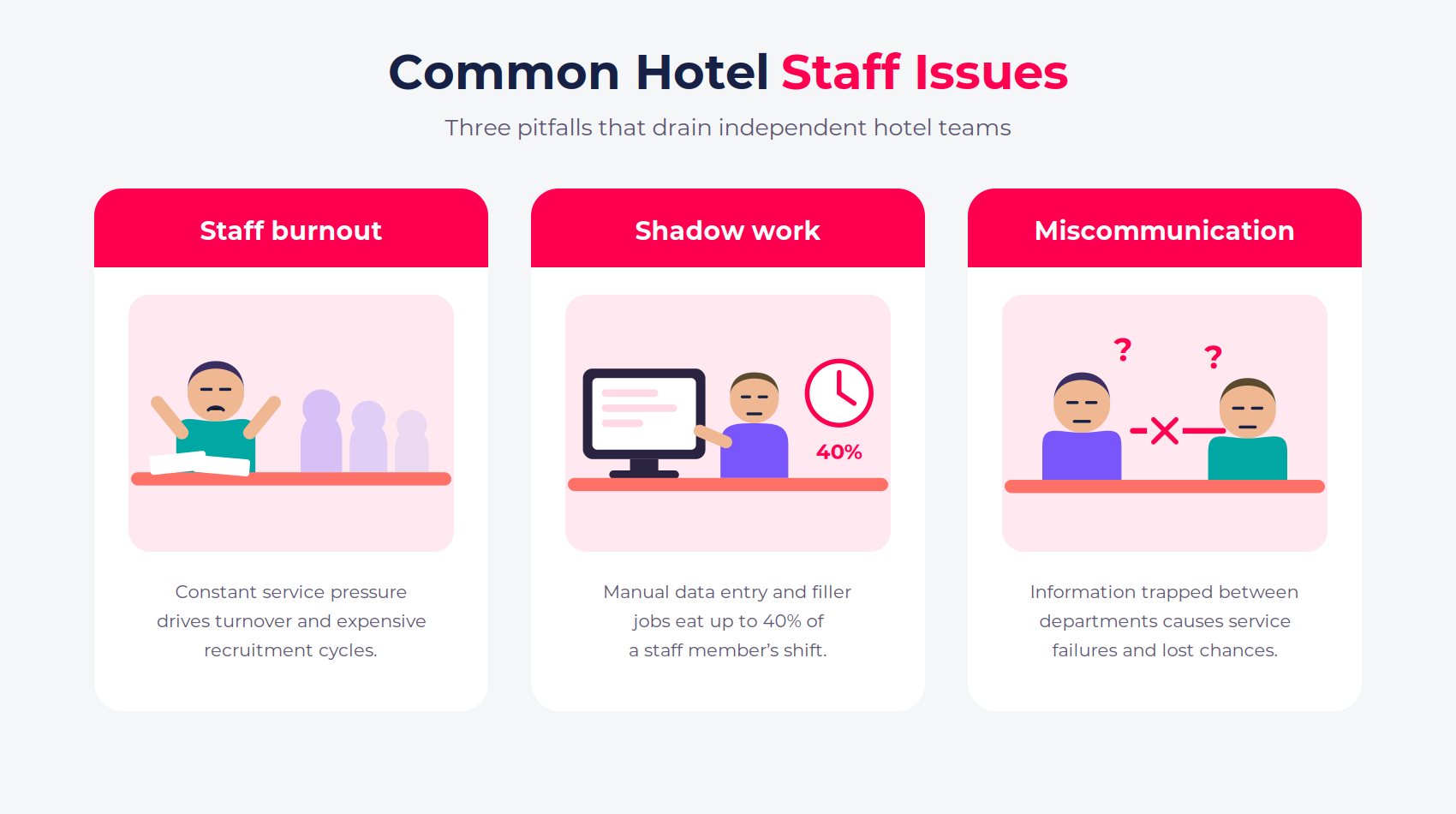
The hospitality sector stands out as one of the EU’s largest employers, making up over 10 million jobs across more than 2 million businesses (Yahoo Finance, 2026). However, acute labour shortages have caused big hits to hotel operations, especially during peak seasons. Most independent properties suffer from three primary pitfalls:
- Staff Burnout: Chronically overworked crew members with constant service pressure leads to high turnover and expensive recruitment cycles.
- Shadow Work: Invisible administrative work and mundane filler jobs like manual data entry and server maintenance consume up to 40% of a staff member's shift.
- Miscommunication: Fragmented decentralised information between departments causes guest service failures and wasted opportunities.
As a result, many hoteliers are exploring digitisation and sustainable tech to turn the tide, and with positive results at that. In fact 89% of hoteliers say that a PMS has saved their teams between 2 - 10 hours per week in operational labour, if not more (Hotel Tech Report, 2026).
But before we look at solutions, let’s address these invisible drains caused not just by staff shortages, but outdated manual systems. In a hotel with a fragmented tech stack, the first to feel the burden of connectivity is always the hotel staff, thus creating a chaos tax that can show up in three damaging ways.
How Can A Modern PMS Solve Hotel Staffing Shortages?
A modern cloud PMS architecture acts as an invisible staff member. It doesn’t just store data, but makes sure that every department is informed in a timely and transparent manner of what to expect, moving from a reactive to a proactive work environment.
A PMS activates data, centralises operations, and automates tasks and communication so that hotel staff can focus on what they do best, take care of guests. In turn, this helps reduce stress and conflict amongst staff, often caused by lack of miscommunication, unexpected developments, and strenuous overtime.
Here are some steps you can take with a PMS and some effective recruitment strategies to snip your staffing problems at the bud:
Virtual Front Desk
The goal here is not to remove the front desk, but to eliminate the need for a 24/7 physical presence without sacrificing guest satisfaction. By automating arrival and departure flows, teams can return focus on high-value guest interactions instead of spending countless hours behind a computer.
Here’s a three step automated arrival workflow to give you an idea of how check in looks with a modern cloud based PMS:
- Pre-Arrival: Your PMS automatically sends an SMS 24 hours before check-in with a link to a digital registration card.
- Payment: Your guest provides payment and ID verification via their own devices, which the PMS system validates instantly. No cross referencing, no wait period.
- Check-In: When the room is ready for your guest, a digital key or PIN code is sent directly to the guest's phone through your PMS system.
By adopting smart check-in tools for independent hoteliers, hotels can ensure that even if the lobby is empty, the guest's experience remains seamless.
Intelligent Housekeeping
Housekeeping is one of the most labour intensive departments in any hotel. In a manual crew setup, a supervisor spends hours walking floors and checking room statuses. With a modern online PMS, this mundane work is replaced by real-time mobile updates.
How does a PMS organise housekeeping efficiently? Let’s take a look:
- Priority Alerts: Not all rooms have the same urgency. A smart PMS system flags early arrival rooms as top priority and places them first on the cleaner's mobile app.
- Instant Sync: As soon as a cleaner marks a room as clean, it is instantly bookable in the PMS and on your integrated booking engine. No more manual holdups.
- Maintenance Tags: Manual systems leave maintenance to be discovered by guests. With a modern PMS, staff can snap a photo of a broken fixture and tag maintenance immediately, preventing a guest from ever seeing the issue.
Implementing automated hotel housekeeping management steps results in a 30% faster room turnover, allowing hotels to accept early check-ins that drive guest loyalty.
Centralised Tech Stack
Software sprawl is a killer of productivity in any hotel operation. When teams have to use four different platforms just to manage one guest, the room for human error skyrockets. In fact, research shows that up to 25% of records can be corrupted or lost when relying on manual data entry across disconnected tools (IBM, 2025).
By centralising the channel manager, booking engine, and CRM into a single source, hotels can reduce the risk of human error to less than 0.5% (DocuClipper, 2025). Not only that, a centralised tech stack also reduces the training time needed for new hires; a critical component of long term staffing strategies for independent hotels.
Hotel Staffing Challenges: Wrap Up
The labour crisis has unveiled that the hospitality industry needs to fundamentally shift its approach to catch up to new realities. In order to thrive, independent hoteliers must pivot from "hiring more people" to empowering the people they have.
By identifying your chaos tax, implementing PMS and HR tech driven staffing solutions, and centralising your hotel tech stack, you can protect your team from burnout, your business from inefficiency, and enjoy key tactical wins such as:
- 70% of admin tasks are automated to let your staff focus on guests.
- £1,000+ per month is reclaimed in wasted labour hours.
A centralised tech stack to reduce training time and manual errors.
Why Noovy?
Most legacy systems are data graveyards, but Noovy’s all in one cloud based platform is designed to turn every last bit of data at your disposal into operational action.
Our automated room status updates eliminate the need for constant radio chatter. When a guest checks out via their mobile, Noovy instantly re-prioritises the housekeeping queue. This ensures your lean team is always working on the most profitable task at any given moment.
Noovy’s integrated CRM allows you to automate guest communication based on real-time data. You don't need a dedicated marketing manager to send "Welcome" or "Thank You" messages when your system does it for you. With Noovy, you can ensure that every guest feels seen, even when your team is stretched thin.
Ready to empower your hotel staff? Book a Demo today!