

What is the Time to Productivity Metric?
In simple terms, how many days does it take for a new hire to handle a front-of-house or back-of-house shift completely on their own?
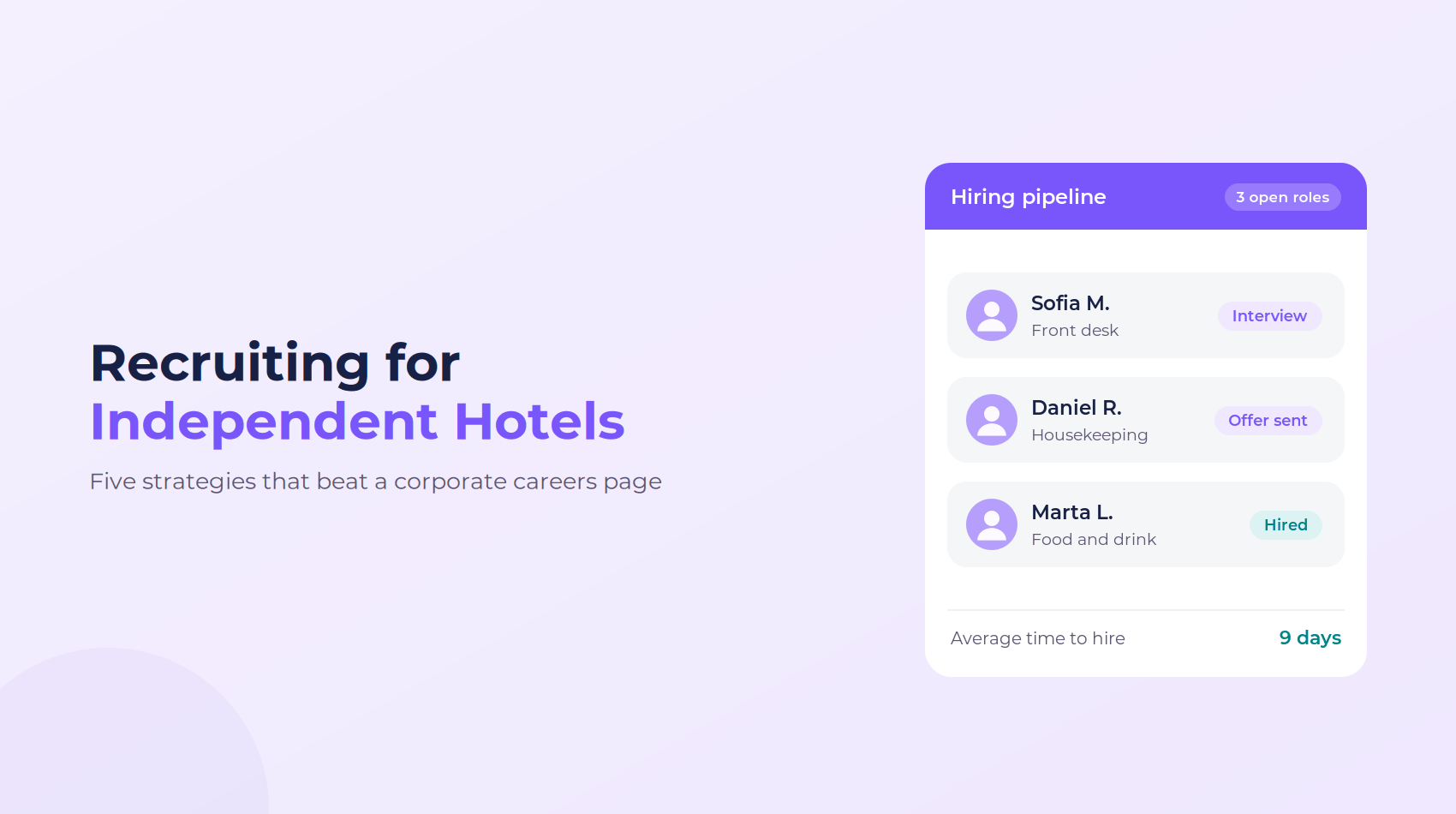

Recruitment in the hospitality industry as an independent hotel often feels like an uphill battle. The European hospitality industry has been facing record labour shortages since COVID-19, with roughly 10% of all roles remaining perpetually vacant (Hotel Management Network, 2026). The traditional cycle of seasonal hiring, lean teams on the brink of burnout, and the frustration of empty shifts has shown the need for a drastic change in hospitality recruitment strategies.
These recruitment stalls affect every part of a hotel operation. Task lists get messier, staff hours get longer, and communication breaks down in the absence of a structured lean team. To break the cycle, independent hotels can utilise a series of hospitality recruitment strategies designed to build a real team, not just fill a shift.
By re-engineering job roles to ease the learning curve and reward performance, hotels can build a stable, professional team that stays for the long haul. If you’re curious on how to hire hotel staff, this tactical guide will introduce you to five key principles for staff retention and walk you through top hotel recruitment strategy tips.
Ready for a happy hotel team? Book a free demo with a Noovy expert today to learn more about our intuitive, automated hotel tech stack designed to empower your staff.
The Advantage of Independent Hotels in Hospitality Hiring
Strategy 1: Source Local Talent via Informal and Micro Networks
Strategy 2: Improve the Employee Value Proposition (EVP)
Strategy 3: Implement an Employee Referral Program
Strategy 4: Recruit for Attitude, Automate for Skill
Strategy 5: Streamline the Onboarding Experience
Measuring Your Hospitality Recruitment ROI
Hospitality Recruitment Strategies: Wrap-Up
Frequently Asked Questions (FAQs)
Many boutique hotels hold the false perception that they are at a net disadvantage when competing with candidates against corporate resorts and international chains. While it may be true that large hotels have equally large HR budgets, they also come with:
This is where recruitment in hospitality for independent hotels offers distinct competitive perks. Hospitality talent is increasingly leaving corporate environments in search of work places that are flexible and free of corporate red tape.
The market backs this, as up to 63% of all European hotel capacity is currently in the hands of small independent hotels, not corporate chains (EY Parthenon, 2021). This growing popularity is not just for guests, but staff alike. This is because small hotels offer:
When executing a hotel recruiting strategy, it’s important for boutique properties to emphasise these cultural benefits, as they are advantages that corporate brands simply cannot match.
When hiring for hotel staff, relying solely on global, passive job boards like Indeed or Monster is an expensive, low-yield recruitment strategy, often leading to generic, low-intent applications. To build a reliable team that is present and attentive, hotels need to start their first search in their local community.
Hotel staff hiring through proactive, hyper-local recruitment helps everyone. It creates a positive reinforcement to the local community that a hotel generates new jobs, and it helps reduce the cost of staff travel, relocation and reliability in the long term.
Instead of waiting for candidates to find your listings on gigantic online job boards, hotels should focus on existing active local networks:
An Employee Value Proposition (EVP) is the unique mix of balance, compensation, and environment a workplace offers its staff in exchange for their skills. Most successful recruitment procedures make use of this approach, as it communicates a transparent exchange of services.
Studies suggest that job listings with a clear employee value proposition can experience up to 50% more exposure, and 30% more commitment from hired employees (Gartner, 2026). If a job description reads like a list of tasks with no clear compensation, it will struggle to attract top talent in the modern hospitality industry.
Modern hotel job seekers value clear schedules, a healthy work-life balance, and reliable tools over vague corporate promises. To make open roles stand out, hotels should focus on these key operational principles:
A hotel's top performing and reliable staff are their best asset for finding new talent, and work as a great hotel staffing solution. High performing employees understand the operational standards, culture, and makeup of a property better than a job application could ever convey.
By viewing top staff as qualified peers who share the same work ethic, hotels can build a stronger network of reliable applicants and save money on HR efforts.
An informal “word of mouth” referral system rarely gets consistent results as there is no clear incentive in place. To yield the best results, hotels need to introduce a transparent, structured financial incentive program:
By splitting a bonus payout across a time range, staff are motivated to bring in candidates who are committed to staying, reducing onboarding friction, lowering hiring costs, and strengthening the hotel's internal team culture.
One of the biggest mistakes any job place makes is requiring years of specific technical experience for entry-level roles. This blocks out real talent and potential as modern hotel staff training is much more intuitive than in the past.
Traditional hotel legacy systems used to have steep learning curves and required deep technical knowhow. With modern, cloud-based hotel software, operating departments are now as intuitive as the social media apps we use everyday.
By shifting perspectives towards hiring for a natural customer service attitude, hotels can assure that the core traits of a good staff member are secured. Technical onboarding is a lot more simple with modern tech solutions, and should not take so much precedence.
An enthusiastic candidate from a retail, restaurant, or customer-support background can easily excel at your front desk if they have the right tools. By replacing confusing, old-school software with intuitive, modern property management platforms, hotels can take a candidate with zero hotel experience and have them confidently manage guest arrivals on their first day.
A successful recruitment doesn't end when a candidate signs an employment contract. In fact, a staggering 42% of new hires in hospitality tend to quit in the first 90 days (Hospitality Net, 2024). The first month on the job is critical as it gives a lot of insight into the new hire.
Modern cloud-based hotel technologies have flattened out the learning curve by introducing software that is as intuitive as the apps we use everyday. This is fantastic news for independent hoteliers, as it reduces weeks of onboarding and profit loss into just several days at most.
The best ways to ensure the smoothest onboarding process is to:
To ensure that a hotel hiring strategy translates into long-term success, hoteliers must regularly track their hiring performance. By keeping an eye on the time to productivity metric, hotel managers can identify whether the onboarding process needs improving:
When recruitment fails and positions remain perpetually open, businesses face real financial costs to fill the gaps. This often hidden impact of an open position can be calculated using the Cost of Vacancy (COV) formula. It looks like this:
Here's an example where an independent hotel has to hold back 8 rooms on a busy weekend due to housekeeping shortages. Each room has an average daily rate (ADR) of €140, and the hotel has to pay €80 in overtime costs to keep the front desk functioning:
COV = (8 x €140) + €80 = €1,200 in losses per day.
An operational drain of €1,200 per day is staggering, and it shows why an efficient hiring process is so important. Using intuitive cloud technology and simplified onboarding processes helps to minimise these costs by cutting training times down and allowing new hires to become fully productive immediately.
An effective hospitality hiring strategy requires more than just collecting resumes and conducting interviews. It’s about nurturing a modern, positive, and welcoming workplace culture where staff want to stay.
By sourcing local talent and building community, offering a clear value proposition and growth opportunities, as well as using modern, cloud-based hospitality tech, hotels can build a reliable team that helps create the dream hotel experience.
Noovy is built from the ground up to support independent hoteliers with their team operations. Our clean, cloud-native hotel system features an intuitive interface that completely eliminates the need for long, complicated training sessions.
By automating manual administrative tasks, like channel manager updates and direct booking delivery, Noovy reduces the workload on your team, protects your staff from operational burnout, and allows you to easily hire and onboard talent from any customer-service background.
Ready to elevate your hotel experience for both your staff and guests? Book a free demo of our tech stack with a Noovy expert today!